
Parts of Speech: English Grammar Guide with Examples
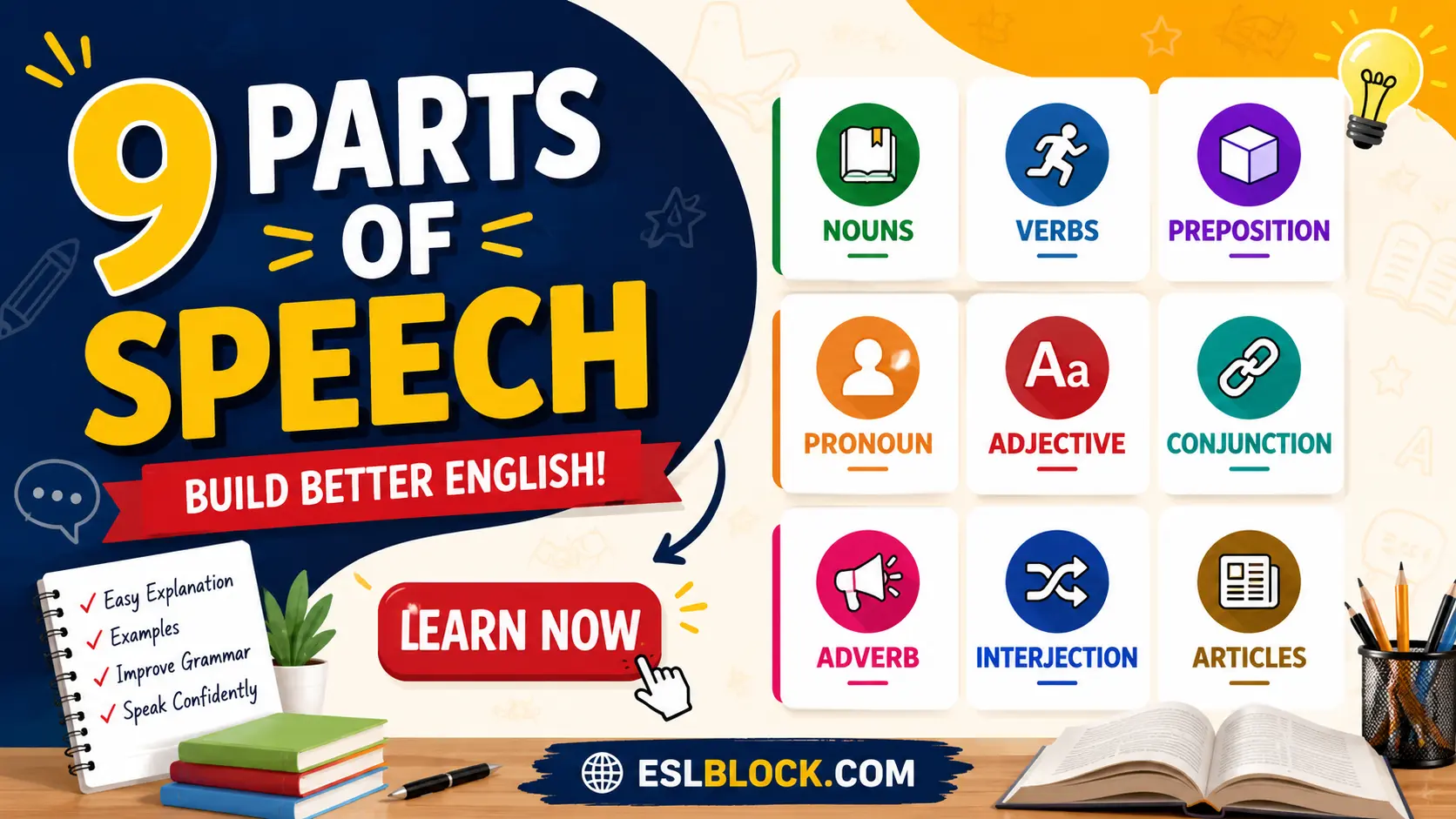
Traditional grammar has 8 parts of speech, as Encyclopaedia Britannica explains. Many modern ESL courses, including ours here at ESLBlock, teach 9, because they add determiners (words like the, a, this and my) as their own word class.
We can sort English words into these 9 types, called parts of speech or “word classes.” Knowing them helps you understand how a sentence works and makes it easier to write good sentences of your own.
Every word is a part of speech. The term “part of speech” describes the job a word does in a sentence, and the same word can do different jobs. For example, play is a verb in “I play football” but a noun in “We watched a play.”
- What Are Parts Of Speech?
- Importance of Parts of Speech in English Grammar
- Words and lexemes
- Open and Closed Word Classes
- Explanation of Different Parts of Speech (with Examples)
- 1. Nouns (n.)
- 2. Verbs (vb.)
- 3. Pronoun (pron.)
- 4. Adjective (adj.)
- 5. Adverb (adv.)
- 6. Preposition (prep.)
- 7. Conjunction (conj.)
- 8. Interjection (interj.)
- 9. Determiners (including Articles)
- Parts of Speech in English – Printable Infographic
- Parts of Speech in English – Printable Flashcards
- Parts of Speech in English MCQs Test
Parts of speech are classifications of words that perform similar roles in grammatical terms in phrase and sentence structure. So what exactly are various parts of speech? And what do you know about which words are related to different grammar categories? This article will describe the various parts of speech and show you how to recognize them and alter and utilize them in both complicated and straightforward sentences.
Within the English language, there are many parts of speech that are arranged to create sentences. Without these elements, the language wouldn’t be able to work.
Learn more about the different parts of speech, the words we use each day, and how to convey ideas effectively.
What Are Parts Of Speech?
The parts of speech comprise categories determined by the role they play in sentence structure. The word categories are arranged according to their function in grammatical terms and the meanings they create and communicate.
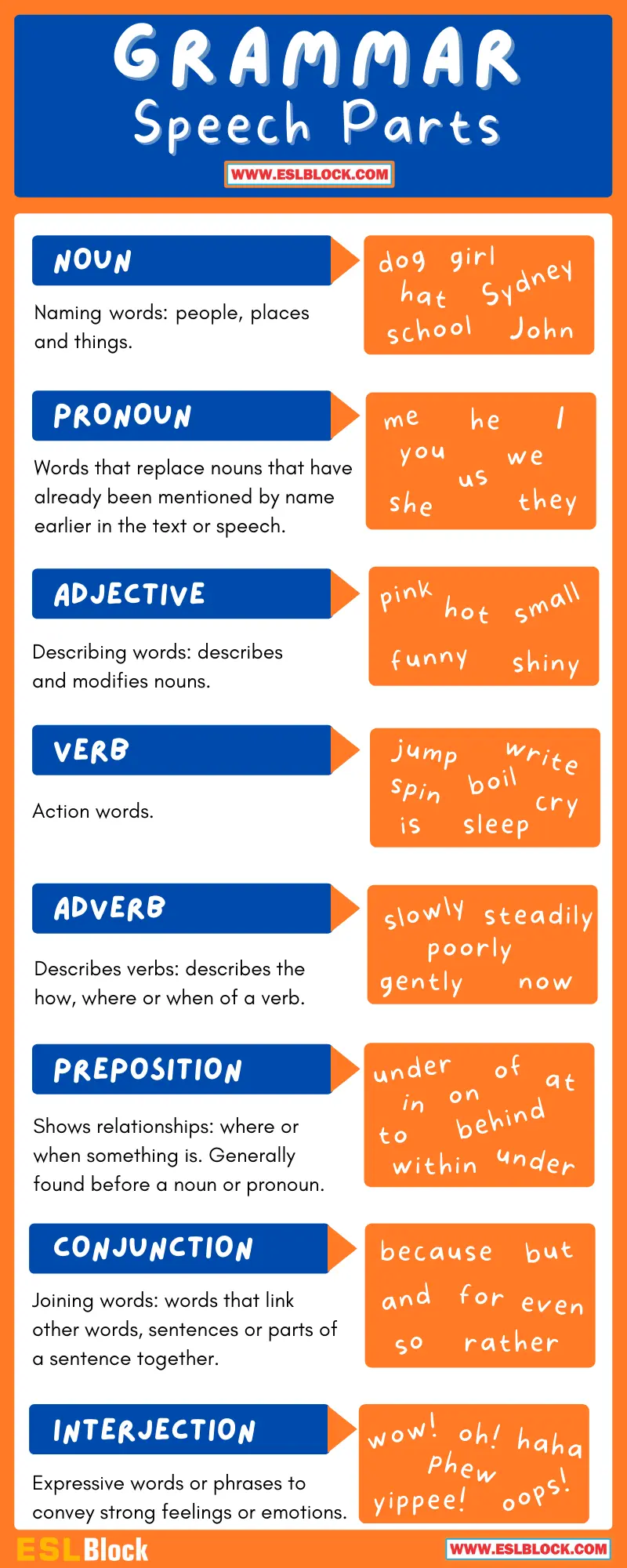
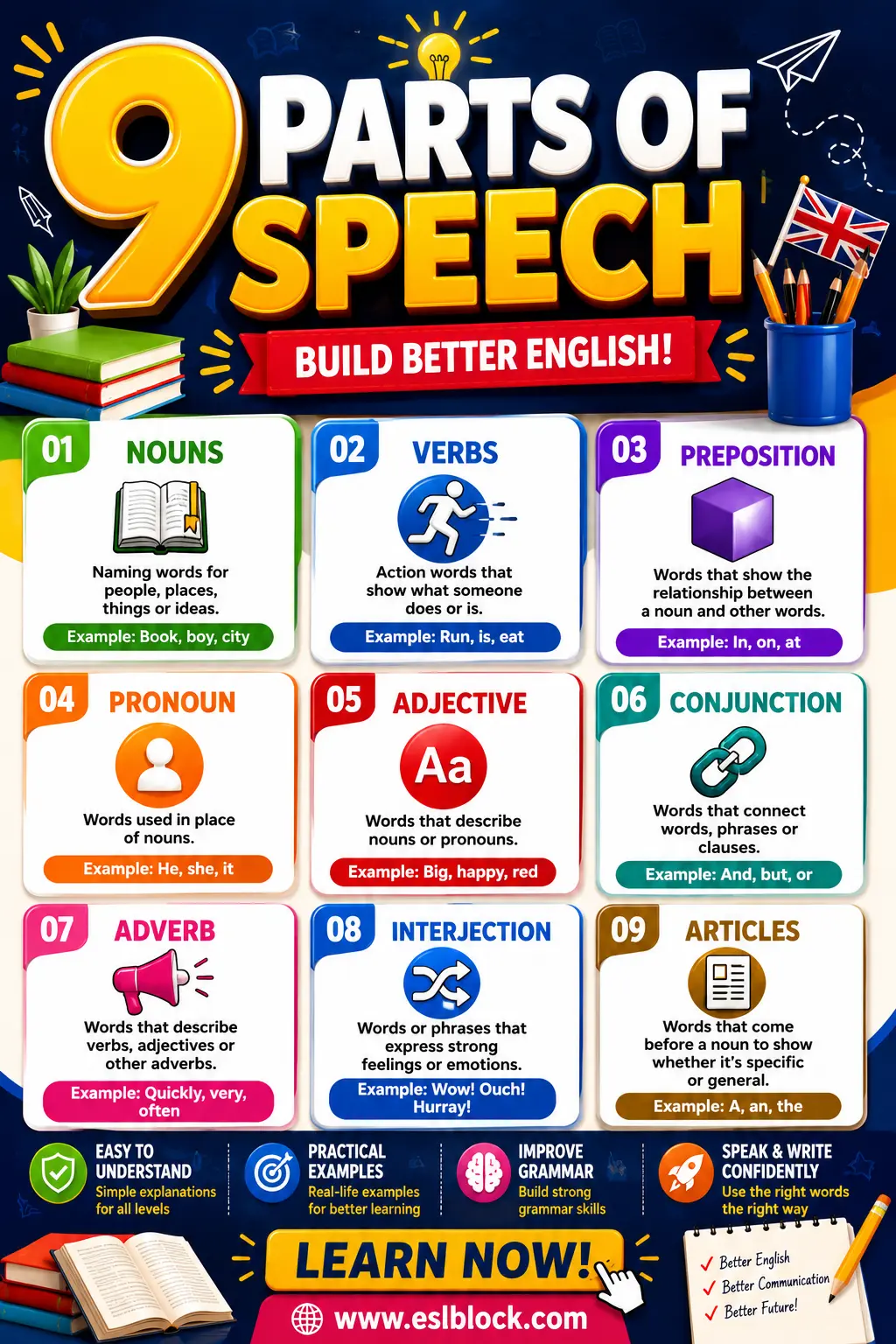
In this guide we cover 9 main parts of speech: nouns, pronouns, verbs, adjectives, adverbs, prepositions, conjunctions, interjections and determiners (including articles).
Although the meanings of these categories will be explained in the following sections, remember that these words are grammatically relevant or perform as grammatical elements in the speech, including sentence structure and meaning.
Importance of Parts of Speech in English Grammar
Learning the parts of speech is one of the best ways to improve your English. They help you build correct sentences, express your ideas clearly, and communicate with confidence. If you’re new to grammar, start with our guide to common nouns, the easiest word class to learn.
1. Clear Communication
Every part of speech has a special job. Nouns name people or things, verbs show actions, and adjectives describe them. Learning basic English grammar helps you choose the right words and avoid confusion.
Clear writing makes every message easier to understand.
2. Strong Sentence Structure
Good sentences need the right order of words. Nouns, verbs, pronouns, and prepositions all work together to create complete ideas. Practicing sentence structure helps you write naturally and confidently.
Strong grammar creates strong communication.
3. More Expressive English
Adjectives, adverbs, and interjections make your speech and writing more interesting. They help you describe people, places, and feelings with greater detail. Building your English vocabulary makes every conversation more enjoyable.
The right words bring your ideas to life.
4. Better Speaking and Writing
Knowing the parts of speech helps you avoid common grammar mistakes. It also improves your reading, listening, speaking, and writing skills. To see how pronouns take the place of nouns, read our guide to types of pronouns.
Practice a little every day.
5. Easier Grammar Learning
Most grammar lessons begin with the parts of speech. Once you understand them, topics like tenses, punctuation, and sentence patterns become much easier. When you’re ready, move on to our guide to the 12 verb tenses, then practice with our verb tenses worksheets.
A strong foundation leads to better English.
Words and lexemes
In linguistics, we separate words from lexemes. Words are what we see and count on the page. For example, everyone can agree on how many words are in this sentence:
Amelia ran 9 kilometers yesterday, but she’s only running 3 today. (11 words)
Look closer, though: ran and running are both forms of the same verb, run. That base word is the lexeme. A lexeme is the dictionary form of a word, and run, runs, ran and running are all forms of it.
Open and Closed Word Classes
Open Classes: Open classes allow new members through borrowing (for example, the noun cafe) and derivation (for example, the adjective bounteous from the noun bounty). Open classes of words include:
- Nouns
- Verbs
- Adjectives
- Adverbs
Closed Classes: Closed classes rarely get new members. They are small groups of words that do grammar jobs. Closed classes of words include:
- Determiners
- Prepositions
- Pronouns
- Conjunctions
Explanation of Different Parts of Speech (with Examples)
This chapter will look a bit more closely at the various components of speech like the verb, noun, and adjective. This will enable us to understand better how sentences are constructed and how all the parts of speech function.
1. Nouns (n.)
A noun is a word that names a person, place, thing or idea. Anything that names a “thing” is a noun, whether it’s a basketball court in San Francisco, Cleopatra, or happiness. There are several kinds of nouns, such as common nouns, proper nouns, collective nouns and possessive nouns. Each has its own job, so let’s look at them in more detail.
Noun Examples
Ball, Jeffrey, cat, Korea, pen, mother, New Year, Lahore, dog, elephant, bat, garden, school, Eid, work, music, town, America, Manila, teacher, Madinah, farmer, Bob, Sean, feet, Michael, police officer, air, France, coffee, football, danger, classroom, happiness, wedding, Christmas.
Noun example sentences
- I live in America.
- Amelia is my sister.
- I love to play with my cat.
- The name of this dog is Jake.
- The Atlantic Ocean is beautiful.
- The capital of England is London.
- Albert Einstein was born in Germany.
- Cara and Bobby are close friends.
- Every Sunday John visits the church.
- I love to collect storybooks.
Common Noun
Common nouns are the simplest kind of noun. They name general people, places, animals and things, not a specific one. That’s why they are not capitalized unless they start a sentence. For example: girl, boy, doctor, town, city, dog and car.
- Kristen has a cup.
- Do you want a pen?
Proper Noun
Proper nouns are the names of specific people, places and things, such as your name, your sister’s name or the name of your city. They always start with a capital letter. Read our detailed article about proper nouns.
- My name is David.
- My mother’s name is Sofie.
- I visited California.
Collective Noun
Collective nouns name a group of people, animals or things. For example, a flock of sheep, a swarm of bees and a team of players.
- A shoal of fish.
- A herd of cattle.
- An army of soldiers.
Possessive Noun
A possessive noun refers to a word that identifies who or what owns something. We can add an apostrophe (‘s) to make most singular nouns possessive form.
- This is William’s pen. (Means – The pen belongs to William)
- Sophia’s homework was checked.
2. Verbs (vb.)
Verbs are words that show an action (run, eat) or a state of being (is, was). Verbs change their form for tense (present or past) and for number (singular or plural).
Verb examples
run, wash, sing, congratulate, dance, believe, seem, finish, eat, complete, drink, play, become, help.
| First Form | Second Form | Third Form |
|---|---|---|
| Eat | Ate | Eaten |
| Run | Ran | Run |
| Write | Wrote | Written |
| Speak | Spoke | Spoken |
| Sing | Sang | Sung |
| Dance | Danced | Danced |
| Sleep | Slept | Slept |
| Go | Went | Gone |
| See | Saw | Seen |
| Do | Did | Done |
| Have | Had | Had |
| Make | Made | Made |
| Take | Took | Taken |
| Give | Gave | Given |
| Come | Came | Come |
| Read | Read | Read |
| Drive | Drove | Driven |
| Break | Broke | Broken |
| Swim | Swam | Swum |
Verb example sentences
- Amelia is playing football.
- We bought a new dog.
- The roof on the shop leaks.
- The lightning struck the tower.
- Will you help me with the kitchen?
- She rode her new bike around the block for an hour.
- The dog sat by the gate.
- I’ll play this song on my guitar.
- She thought about her silly mistake in the exam.
- John visited his friend for a while and then went to the market.
- She danced gracefully at the party last night.
- The sun rises early in the morning.
- I read an interesting book over the weekend.
- They spoke passionately about their travel experiences.
- The chef cooked a delicious meal for the guests.
- He runs five miles every day for his fitness.
- The children played happily in the park.
- We sang our favorite songs together at the concert.
- She writes poetry in her free time.
- The cat sleeps peacefully on the windowsill.
Kinds of Verbs
Every complete sentence needs a verb. Here are the main kinds of verbs.
- Regular verbs
- Irregular verbs
- Modal verbs
- Dynamic verbs
- Auxiliary verbs
- Stative verbs
- Linking Verbs
- Transitive Verbs
- Finite Verbs
- Infinitive Verbs
- Intransitive Verbs
- Causative verbs
Explore the full list of verbs from A to Z
3. Pronoun (pron.)
A pronoun is a word used in place of a noun. The noun substituted by a pronoun can be known as an antecedent. For example, in the sentence, I love my bunny because he is a good boy, the word he in the sentence is a pronoun that replaces the noun bunny.
In grammatical terms, pronouns behave like nouns. They can be used for subjects and objects; They refer to persons, places, and things; they can be plural or singular.
Pronoun Examples
I, me, you, yours, he, himself, she, herself, it, its, we, they, us, them, who, what, this, that, anyone, nobody, something.
Pronoun Example Sentences
- We looked for Sofia at her house, but she wasn’t there.
- I took my bike to the mechanic to get it repaired.
- This is the best evening ever!
- Someone donated $1500 to our charity.
- Kristen thinks that mayonnaise goes well with anything.
- Oliver isn’t at work this week; he’s gone on holiday.
- Tell her the truth.
- Isabella tried it herself.
- They can’t blame him for everything.
- The man who called yesterday wants to buy the car.
Kinds of Pronouns
There are many kinds of pronouns we can use in our writing and speech. First, we will briefly discuss the various types. Then, if you’d like to look into each of them in greater depth, we’ve provided comprehensive information on each of the pronouns.
- Personal pronouns
- Possessive pronouns
- Relative pronouns
- Reflexive pronouns
- Indefinite pronouns
- Interrogative pronouns
- Demonstrative pronouns
- Reciprocal pronouns
- Intensive pronouns
4. Adjective (adj.)
An adjective is a word that describes a noun or pronoun. It adds to the meaning of the noun. For example, we all know what the word “boy” means. But a clever boy is different from a tired boy, and a happy boy is different from a sad boy. The word “boy” means the same thing each time, but the adjectives clever, tired, happy and sad change the picture completely.
Adjective Examples
Adorable, adventurous, aggressive, agreeable, alert, alive, amused, angry, annoyed, annoying, anxious, fast, cool, dry, blue, smart, short, heavy, hot, green, red, interesting, large.
Adjective Example Sentences
- I have a tall dog. (The word ‘tall’ is describing an attribute of the dog)
- She is smart. (The word ‘smart’ is providing information about the subject)
- The hungry ducks are quacking.
- I saw a flying crow.
- This is a white bag.
- The large squirrel ran up the wall.
- My sister has long hair.
- The sky became dark.
- Her story seemed interesting.
- Furry cats may overheat in the summertime.
Kinds of Adjective
Here, we will briefly look at 13 different types of adjectives. To learn about each one in more depth, see our full guide to the different kinds of adjectives.
- Possessive adjectives
- Comparative adjectives
- Superlative adjectives
- Descriptive adjectives
- Predicate adjectives
- Compound adjectives
- Demonstrative adjectives
- Proper adjectives
- Participial adjectives
- Limiting adjectives
- Interrogative adjectives
- Distributive adjective
- Attributive adjectives
5. Adverb (adv.)
An adverb describes a verb, an adjective or another adverb. Adverbs add detail and help the listener picture what is happening. Many adverbs end in -ly, but some don’t, such as very, never and well.
Adverbs tell us when, where, how, how often and to what extent something happens. Learn more in our guide to the types of adverbs.
Adverb Examples
Softly, neatly, lazily, very, badly, fully, often, only, nearly, hungrily, hopefully, silently, well, really, sometimes
Adverb Example Sentences
- Amelia speaks loudly. (How does Amelia speak?)
- Afterwards, he went home. (When did he go home?)
- Mia lives locally. (Where does Mia live?)
- This is an extremely tall tree.
- They have a very large cat.
- Tom’s team did not play badly.
- William is very kind.
- Fortunately, Sofia recorded William’s win.
- She drives quickly.
- The baby is crying loudly.
6. Preposition (prep.)
Prepositions are some of the most common words in English. Words like of, in, to and for appear in almost every sentence. Prepositions connect a noun or pronoun to the rest of the sentence and show how they are related, for example in time or place.
Words like in, on, at, to, before and between are examples of prepositions. See our full list of prepositions with examples.
A preposition comes before a noun or pronoun and forms a prepositional phrase, such as under the table or after lunch. A prepositional phrase usually works like an adjective or an adverb.
Preposition Examples
About, above, across, after, against, along, among, at, before, by, for, from, in, inside, into, of, on, onto, over, to, up, with.
Preposition Example Sentences
- The dog is sitting on the table.
- I am going to the salon after my lunch.
- We are running in the gym.
- The moon is above the clouds.
- I read the news in the newspaper.
- The cat was hiding under the table.
- She drove over the bridge.
- She lost her bracelet at the beach.
- The grammar book belongs to David.
- We were sitting by the tree.
7. Conjunction (conj.)
Conjunctions are words that join words, phrases and clauses. Some of the most common ones are and, or, but, so, because, if and when.
Conjunction Examples
Whether, and, or, so, after, yet, since, before, either, neither, because, unless, as, but, for, just as, nor, not only.
Conjunction Example Sentences
- My friend and I are going to the park.
- Sofia will go to the shop but not before she has had something to eat.
- He was tired yet he still went to the gym.
- I tried to hit the nail but hit my thumb instead.
- I have two dogs and a goldfish.
- She wanted a bike, so she saved her pocket money.
- They can have apple ice cream or a brownie sundae.
- Neither the red dress nor the white one looks right on her.
- My parents worked hard so we could afford a new car.
- They can watch a movie if they finish their homework.
Types of Conjunction
Many different kinds of conjunctions can perform various tasks within sentence structures. This includes:
8. Interjection (interj.)
An interjection is a word or short phrase that shows a sudden feeling, such as surprise, joy or pain. Interjections are often followed by an exclamation mark.
Interjection Examples
Oh!, Wow!, Oops!, Ahem!, Aha!, Gosh!, Aw!, Great!, Hey!, Hi!, Hooray!, Yeah!, Phew!, Eh!, Ouch!, Well!
Interjection Example Sentences
- Good! Now we can start the party.
- Wow! Did you see how big that elephant was?
- Hooray! Amelia passed her exam!
- Oh, I forgot my homework!
- Hey! Wait for me!
- Yes! I can do it.
- Congrats! You finally got your bachelor’s degree.
- Phew! That was a close call.
- No! I don’t want to go yet.
- Well, what did you say?
Types of Interjection
You can use a verb, a noun or an adverb as an interjection. See our guide to the types of interjections for more examples.
- Noun as an interjection
- Verb as an interjection
- Adverb as an interjection
9. Determiners (including Articles)
Determiners come before a noun and tell us which one, whose, or how many. The most common determiners are the articles a, an and the. Determiners are a bit like adjectives, but instead of describing the noun, they point to it or count it.
Articles and determiners are two parts of speech used alongside noun phrases or nouns to help clarify their meaning.
Some older grammar books treat articles (a, an, the) as a separate part of speech. Modern grammar puts them inside the larger group of determiners, which is why this guide counts 9 parts of speech, not 10.
Articles and Determiner Examples
- Numbers: three, seven, ninety-nine
- Distributives: neither, either, half, both, every, each, all
- Possessive determiners: her, his, its, your, their, my, our
- Difference determiners: another, the other, other
- Demonstratives: this, that, these, those
- Quantifiers: a few, a little, much, many, some, most, any, enough
- Pre-determiners: such, quite, rather, what.
- Articles: the, a, an
Articles and Determiner Example Sentences
- All nations want to be free.
- I saw a bike accident.
- These dogs are friendly.
- My family is very happy.
- Many people use Pinterest.
- You have five days left to complete that project.
- Sorry, I’m too busy. I have another job to do.
- Amelia saw a star last night.
- William saw the moon last night.
- Sophia has a beautiful doll.
Parts of Speech in English – Printable Infographic
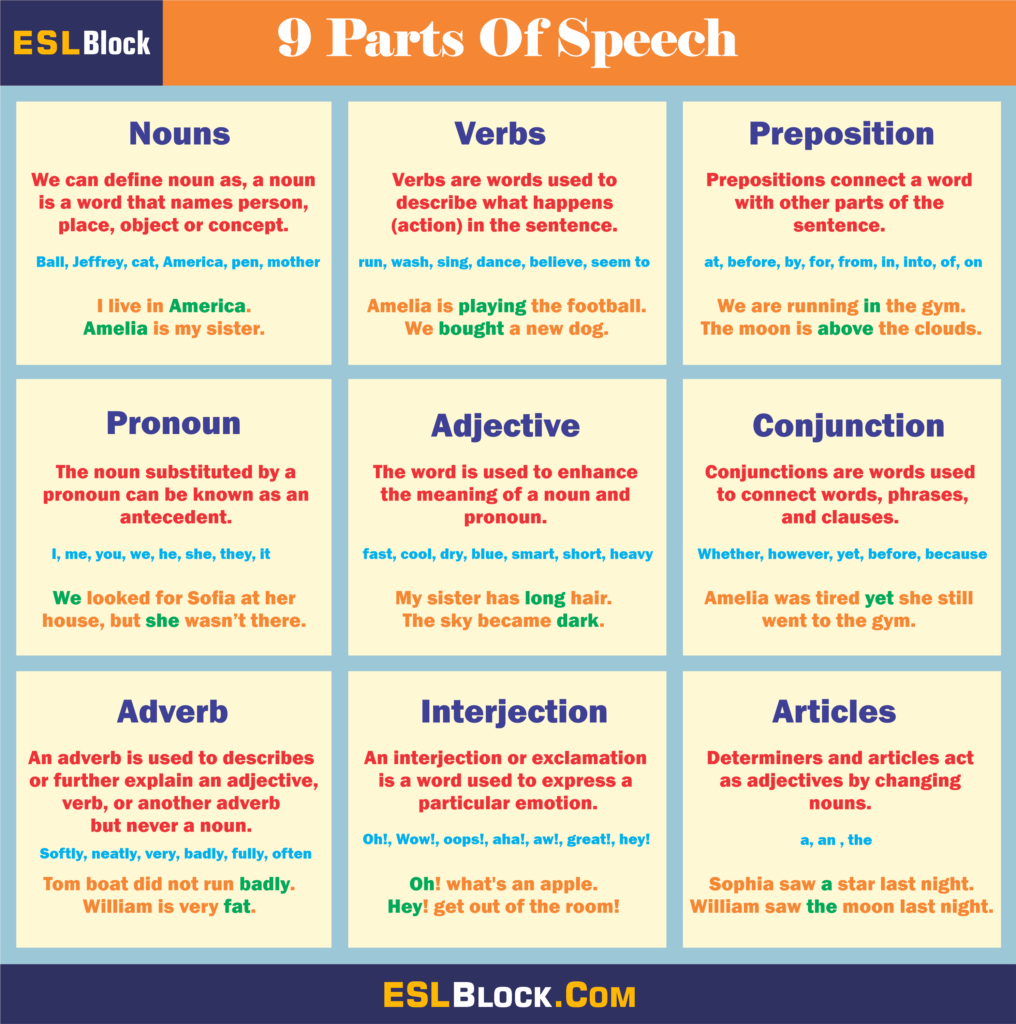
This infographic shows the 9 parts of speech in English, what each one does, and an example of each in a sentence. Without them, we couldn’t form clear sentences, so it’s worth knowing the job each one does.
Infographics are a quick, fun way to review a lot of information at once. Save or print this parts of speech infographic to use in class or for revision.
Parts of Speech in English – Printable Flashcards
Parts of speech can be tricky to spot in a sentence. These flashcards show what each part of speech is and the job it does, so you can practice identifying all 9 parts of speech.
Parts of Speech in English MCQs Test
Use this parts of speech quiz to test your own English grammar or your students’. Click START QUIZ to begin. Have fun!
You can take this grammar test online. It checks what you have learned on this page.



This guide on parts of speech is absolutely fantastic! I especially appreciate how you broke down the 10 different categories. It can get really confusing with all the varying counts out there, but your explanation makes it so clear and easy to follow. The examples for each section are incredibly helpful for solidifying the concepts. I’m wondering, for advanced learners, are there any common pitfalls or specific parts of speech that tend to be more challenging to master than others?