
Active and Passive Voice: Difference, Rules and Examples
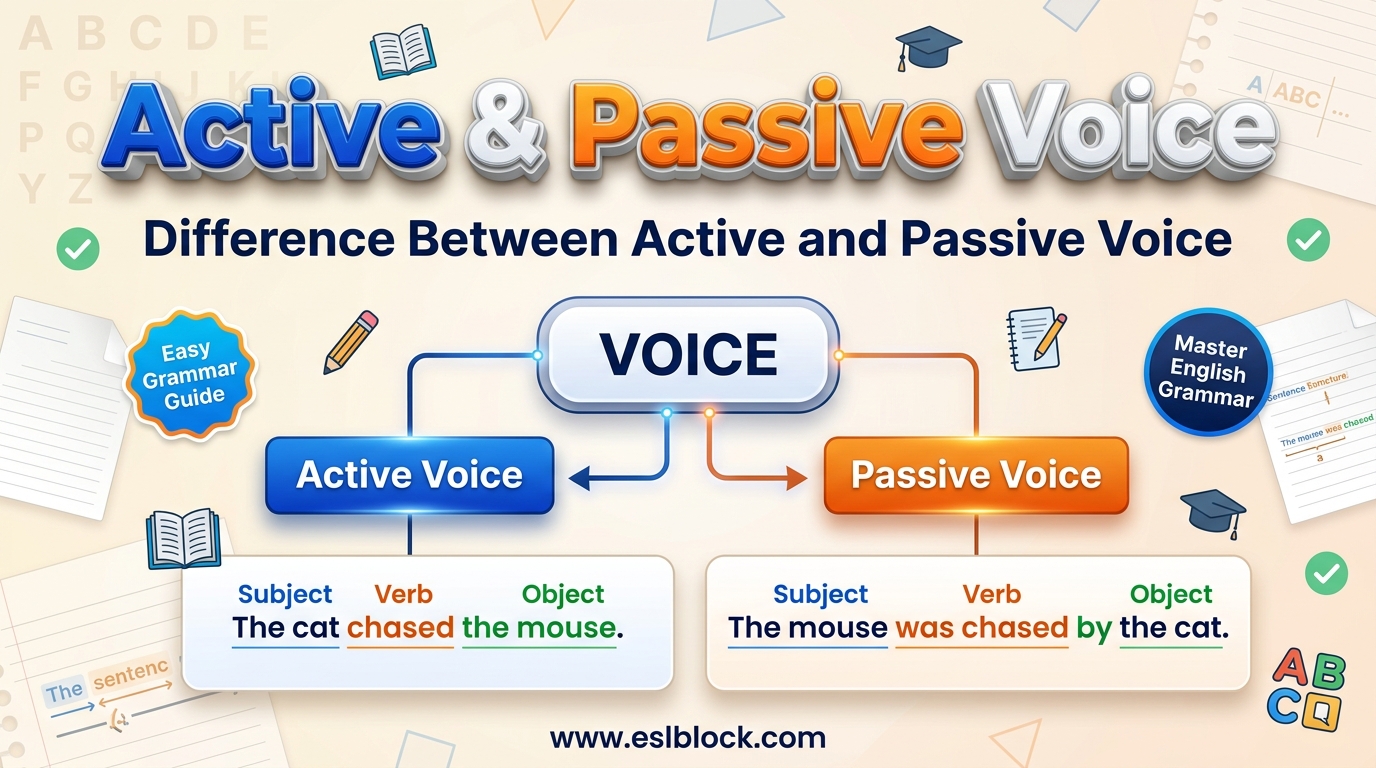
Every sentence with an action can be written in one of two voices. In the active voice, the subject does the action: The chef cooked the meal. In the passive voice, the subject receives the action: The meal was cooked by the chef. Both are correct English. They put the focus in different places.
This guide explains what each voice is, how to change an active sentence into the passive in every tense, when to use each one, and common mistakes to avoid. At the end, test yourself with our free quiz.
What Is the Active Voice?
In the active voice, the subject is the doer: the person or thing that performs the action of the verb. Active sentences follow the usual English word order, so they are usually shorter, clearer and more direct.
Structure: Subject (doer) + verb + object (receiver)
Active Voice Example Sentences
- Dad read the novel in two days.
- She cleans the kitchen every Sunday.
- Jake painted the entire wall.
- Sophia followed the thief.
- The students watched the comet.
- She told them the truth.
- The teacher will give you the instructions.
- Thousands of tourists visit Bali every year.
- Salt water corroded the metal beams.
- The children are building a sandcastle.
What Is the Passive Voice?
In the passive voice, the subject is the receiver: the person or thing that the action happens to. The doer moves to the end of the sentence after by, or it is left out completely. As Britannica notes, the passive shifts the focus from the doer to the receiver of the action.
Structure: Subject (receiver) + a form of be + past participle (V3) + (by + doer). Many common verbs have irregular past participles, such as written, eaten and stolen.
Passive Voice Example Sentences
- Bananas are loved by monkeys.
- The money was counted by the shopkeeper.
- The lamp was knocked over by William.
- The bathroom has been cleaned.
- An old truck was found in the forest.
- The mango was eaten by Amelia.
- The meat was eaten by the lion.
- The coins were collected by Victor.
- English is spoken all over the world.
- The new bridge will be opened next month.
Difference Between Active and Passive Voice
Here is the same sentence in both voices. Notice how the receiver moves to the front and the verb changes:
| Active voice | Passive voice | |
|---|---|---|
| Focus | the doer of the action | the receiver or the action itself |
| Subject | the doer | the receiver |
| Verb form | normal verb (chased) | be + past participle (was chased) |
| The doer | always named, at the start | after by, or left out |
| Style | short, clear, direct | longer, more formal or impersonal |
Active and Passive Sentence Pairs
- Active: Oliver likes Olivia. → Passive: Olivia is liked by Oliver.
- Active: Mother was cooking dinner last night. → Passive: Dinner was being cooked by Mother last night.
- Active: The children have cleaned the bike. → Passive: The bike has been cleaned by the children.
- Active: Someone stole my phone. → Passive: My phone was stolen.
- Active: The company will hire ten new workers. → Passive: Ten new workers will be hired.
- Active: Shakespeare wrote Hamlet. → Passive: Hamlet was written by Shakespeare.
How to Change Active Voice to Passive Voice
Follow these four steps to turn any active sentence with an object into the passive:
Only sentences with an object can become passive, so you need a transitive verb (write a letter, catch a fish). Intransitive verbs such as arrive, sleep and happen have no object, so they have no passive form. You can’t say He was arrived.
Passive Voice in Different Tenses
The verb be shows the tense in a passive sentence, and the main verb stays as a past participle. This table shows the same sentence in the most common verb tenses:
| Tense | Active voice | Passive voice |
|---|---|---|
| Simple present | Tom cleans the room. | The room is cleaned by Tom. |
| Present continuous | Tom is cleaning the room. | The room is being cleaned by Tom. |
| Present perfect | Tom has cleaned the room. | The room has been cleaned by Tom. |
| Simple past | Tom cleaned the room. | The room was cleaned by Tom. |
| Past continuous | Tom was cleaning the room. | The room was being cleaned by Tom. |
| Past perfect | Tom had cleaned the room. | The room had been cleaned by Tom. |
| Simple future | Tom will clean the room. | The room will be cleaned by Tom. |
| Future perfect | Tom will have cleaned the room. | The room will have been cleaned by Tom. |
| With a modal verb | Tom can clean the room. | The room can be cleaned by Tom. |
The perfect continuous tenses (has been being cleaned) are grammatically possible but very rare, so most speakers avoid them. The forms of be, have and will used here are auxiliary verbs.
When to Use Active and Passive Voice
For everyday writing, the active voice is usually the better choice because it is clearer and uses fewer words. The passive voice is still correct, and in some situations it works better:
- the doer is important: Mia won the race.
- you want clear, direct sentences
- you are writing stories, emails and everyday English
- the doer is unknown: My bike was stolen.
- the doer is obvious or unimportant: The thief was arrested.
- the action or result matters most: The bridge was built in 1932.
- you are writing formal or scientific texts: The water was heated to 100°C.
Scientists and academic writers often prefer the passive because it keeps attention on the method and the results rather than on the researcher. Storytellers sometimes use it to hide who did something until later. To choose, ask yourself: what do I want the reader to notice first, the doer or the action? Read more about grammatical voice on Britannica.
Common Mistakes with the Passive Voice
| Wrong | Right | Why |
|---|---|---|
| The cake was eat by Tom. | The cake was eaten by Tom. | The passive needs the past participle (V3), not the base verb. |
| The letter written yesterday. | The letter was written yesterday. | Don’t forget the form of be. |
| The window was broke. | The window was broken. | Broke is the past form; the past participle is broken. |
| He was arrived late. | He arrived late. | Arrive is intransitive, so it has no passive. |
| The cars is washed every week. | The cars are washed every week. | Be must agree with the new subject. |
| The house was built from my grandfather. | The house was built by my grandfather. | Introduce the doer with by. |
Frequently Asked Questions
What is the difference between active and passive voice?
In the active voice, the subject does the action (The dog bit the boy). In the passive voice, the subject receives the action (The boy was bitten by the dog). The meaning stays the same, but the focus changes.
How do you change an active sentence into the passive?
Move the object to the front as the new subject, use a form of be in the same tense plus the past participle, and add by + the doer if it is important: Sara wrote the letter → The letter was written by Sara.
Is the passive voice grammatically wrong?
No. The passive voice is correct. It is only a problem when it makes a sentence longer or less clear than it needs to be.
Can every sentence be made passive?
No. Only sentences with an object can become passive. Verbs without an object, such as arrive, sleep and die, have no passive form.
Do you always need “by” in a passive sentence?
No. Most passive sentences leave out the doer, especially when it is unknown, obvious or unimportant: My wallet was stolen. English is spoken here.
Which voice should I use in essays and reports?
Use the active voice for most sentences because it is clearer. Use the passive when the action or result matters more than who did it, such as when describing a scientific method.
How can I recognise the passive voice?
Look for a form of be (is, was, has been, will be) followed by a past participle (made, written, cleaned). If you can add “by someone” after the verb, the sentence is probably passive.
Practice Active and Passive Voice
Test yourself with our free active and passive voice quiz, then practice with these printable active and passive voice worksheets. To learn more about how sentences are built, read our guides to sentence types and the nine parts of speech.
Have a question about active and passive voice? Leave a comment below and we’ll get back to you as soon as we can.



This was a really insightful post! I especially found the “when to use” section helpful. I’m curious, for creative writing, beyond mystery novels, are there other genres or specific scenarios where passive voice can actually *enhance* the narrative rather than just being a stylistic choice to hide an actor?