Types of Trains: A Fun Guide to 20 Railway Vehicles
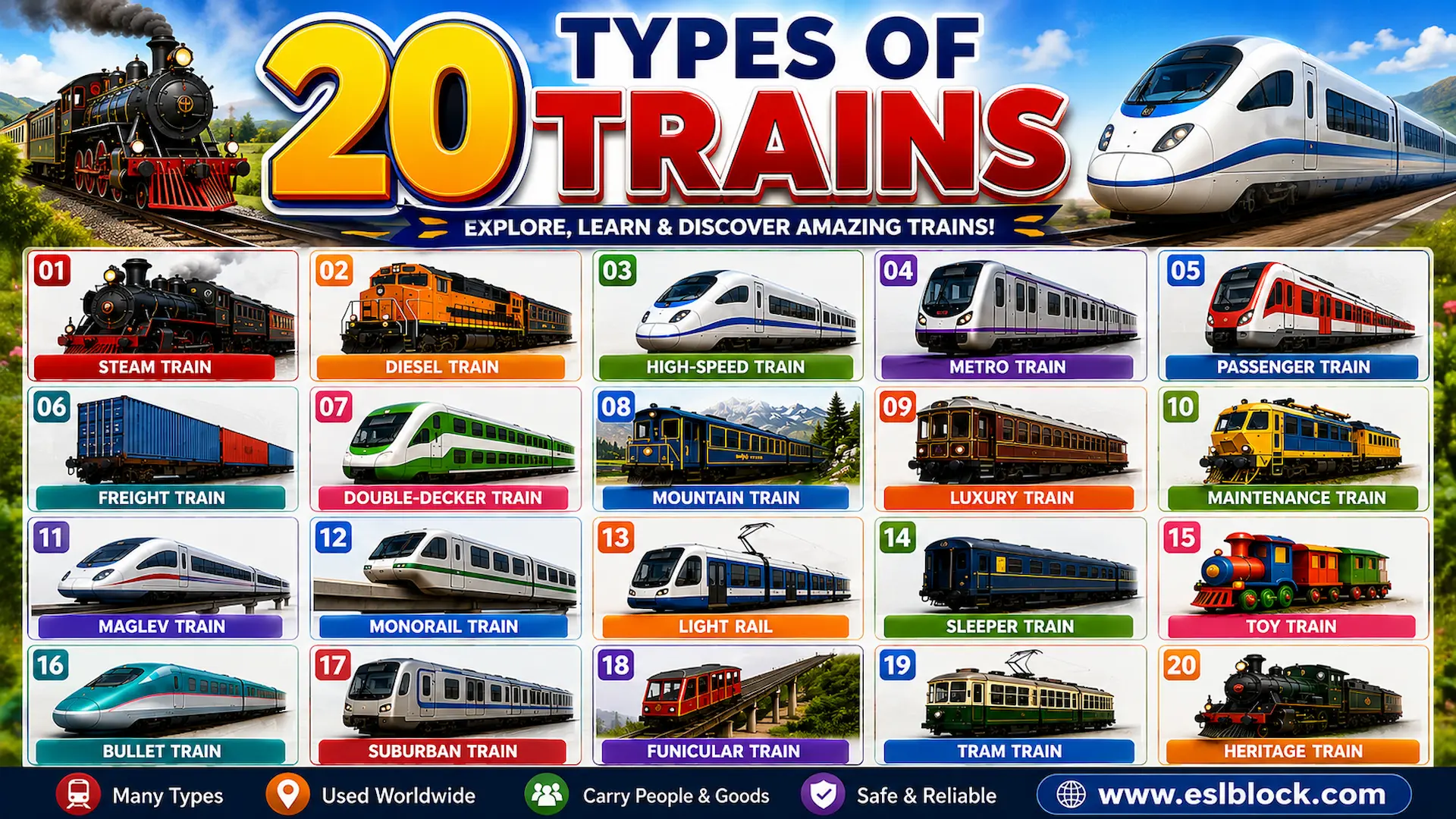
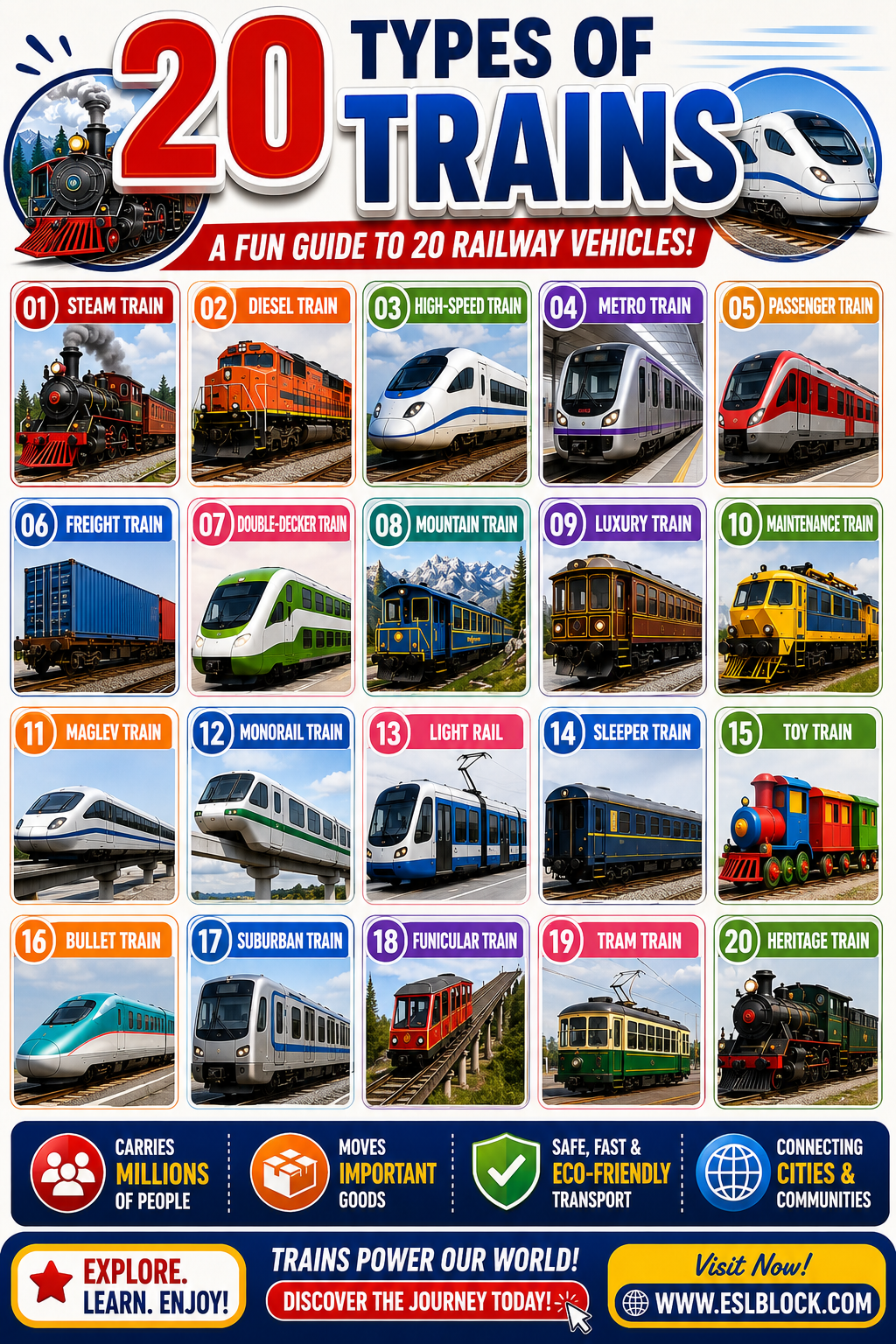
Types of trains have changed a lot over the years. Some carry people across cities, while others transport heavy goods around the world.
Trains are fast, safe, and important. Let’s explore twenty popular train types and discover what makes each one special.
If you enjoy learning about transportation, you may also like our guide to types of tomato for another fun vocabulary lesson.
1. Steam Train
(Pronunciation: STEEM TRAYN | Origin: Steam-powered locomotives became popular during the Industrial Revolution.)
Steam trains use hot steam to move their engines. They were once the most common trains in the world. Many are now preserved as railway heritage attractions.
The sound of a steam whistle is unforgettable. A moving piece of history.
2. Diesel Train
(Pronunciation: DEE-zuhl TRAYN | Origin: Developed during the early 1900s.)
Diesel trains run on diesel fuel instead of steam. They are powerful and can travel long distances without electric wires.
Many countries still use them for passenger and freight services. Strong and reliable.
3. High-Speed Train
(Pronunciation: HY SPEED TRAYN | Origin: Modern high-speed rail began in Japan.)
High-speed trains can travel much faster than regular trains. Famous high-speed rail networks connect major cities in many countries.
Speed meets comfort.
4. Metro Train
(Pronunciation: MET-roh TRAYN | Origin: Named after metropolitan railway systems.)
Metro trains carry thousands of people every day inside busy cities. Most travel underground or on raised tracks.
They’re one of the fastest ways to avoid traffic. City life depends on them.
5. Passenger Train
(Pronunciation: PASS-in-jer TRAYN | Origin: Built to transport travelers.)
Passenger trains are designed for people instead of cargo. They often include comfortable seats, restrooms, and dining cars.
They connect towns and cities every day. Built for the journey.
6. Freight Train
(Pronunciation: FRAYT TRAYN | Origin: Freight means goods or cargo.)
Freight trains move heavy goods like coal, cars, grain, and containers. Some are over two kilometers long. Modern freight rail transport keeps businesses moving.
They power the economy.
7. Double-Decker Train
(Pronunciation: DUB-ul DEK-er TRAYN | Origin: Designed to carry more passengers.)
Double-decker trains have two passenger levels. They offer extra seating without making trains longer.
Perfect for crowded routes.
8. Mountain Train
(Pronunciation: MOUN-tin TRAYN | Origin: Built for steep mountain railways.)
Mountain trains climb steep hills using special tracks and powerful engines. They often offer breathtaking views.
The journey is part of the adventure.
9. Luxury Train
(Pronunciation: LUK-shur-ee TRAYN | Origin: Luxury rail travel became popular in the 1800s.)
Luxury trains feel like moving hotels. Guests enjoy fine meals, private cabins, and beautiful scenery.
Travel in style.
10. Maintenance Train
(Pronunciation: MAYN-tuh-nuhns TRAYN | Origin: Used to maintain railway lines.)
Maintenance trains repair tracks, signals, and overhead wires. They help keep railways safe every day.
Quiet heroes of the railway.
11. Maglev Train
(Pronunciation: MAG-lev TRAYN | Origin: Short for magnetic levitation.)
Maglev trains float above the track using powerful magnets. This amazing magnetic levitation technology reduces friction and increases speed.
Almost flying.
12. Monorail Train
(Pronunciation: MON-oh-rayl TRAYN | Origin: Mono means one.)
Monorail trains run on a single rail instead of two. They’re common in airports and modern cities.
Simple but smart.
If you enjoy learning how things work, you’ll also love our article about parts of the brain.
13. Light Rail
(Pronunciation: LYTE RAYL | Origin: A lighter form of urban railway.)
Light rail trains serve towns and smaller cities. They stop more often than metro systems.
Easy and efficient.
14. Sleeper Train
(Pronunciation: SLEEP-er TRAYN | Origin: Named after sleeping compartments.)
Sleeper trains allow passengers to sleep while traveling overnight. Many include beds and private cabins.
Wake up somewhere new.
15. Toy Train
(Pronunciation: TOY TRAYN | Origin: Small trains made for children and parks.)
Toy trains entertain children and visitors. Some ride through parks, while others are miniature railway models.
Small train. Big smiles.
16. Bullet Train
(Pronunciation: BOOL-it TRAYN | Origin: Nickname for Japan’s Shinkansen.)
Bullet trains are famous for incredible speed and smooth rides. Japan’s Shinkansen system is known around the world.
Fast and graceful.
17. Suburban Train
(Pronunciation: suh-BUR-bun TRAYN | Origin: Designed for suburbs around cities.)
Suburban trains carry commuters between neighborhoods and city centers. They run every day during busy hours.
They keep cities connected.
18. Funicular Train
(Pronunciation: fyoo-NIK-yuh-ler TRAYN | Origin: From the Latin word for rope.)
Funicular trains move up steep hills using cables. They are common in mountain towns and tourist areas.
Straight up.
19. Tram Train
(Pronunciation: TRAM TRAYN | Origin: Combines tram and railway features.)
Tram trains can travel on city streets and railway tracks. This makes them flexible for urban travel.
One train. Two worlds.
20. Heritage Train
(Pronunciation: HAIR-i-tij TRAYN | Origin: Preserved for historical value.)
Heritage trains keep railway history alive. Volunteers and museums restore old locomotives so future generations can enjoy them. Many people visit railway museums to experience these classic trains.
History still rolls forward.
Learning about trains helps us understand how people and goods travel around the world. Every train has its own job and story. The next time you hear a train whistle, you’ll know there’s much more behind the journey.