Types of Scorpions: 12 Amazing Species You Should Know About
Scorpions look scary. But most of them just want to be left alone.
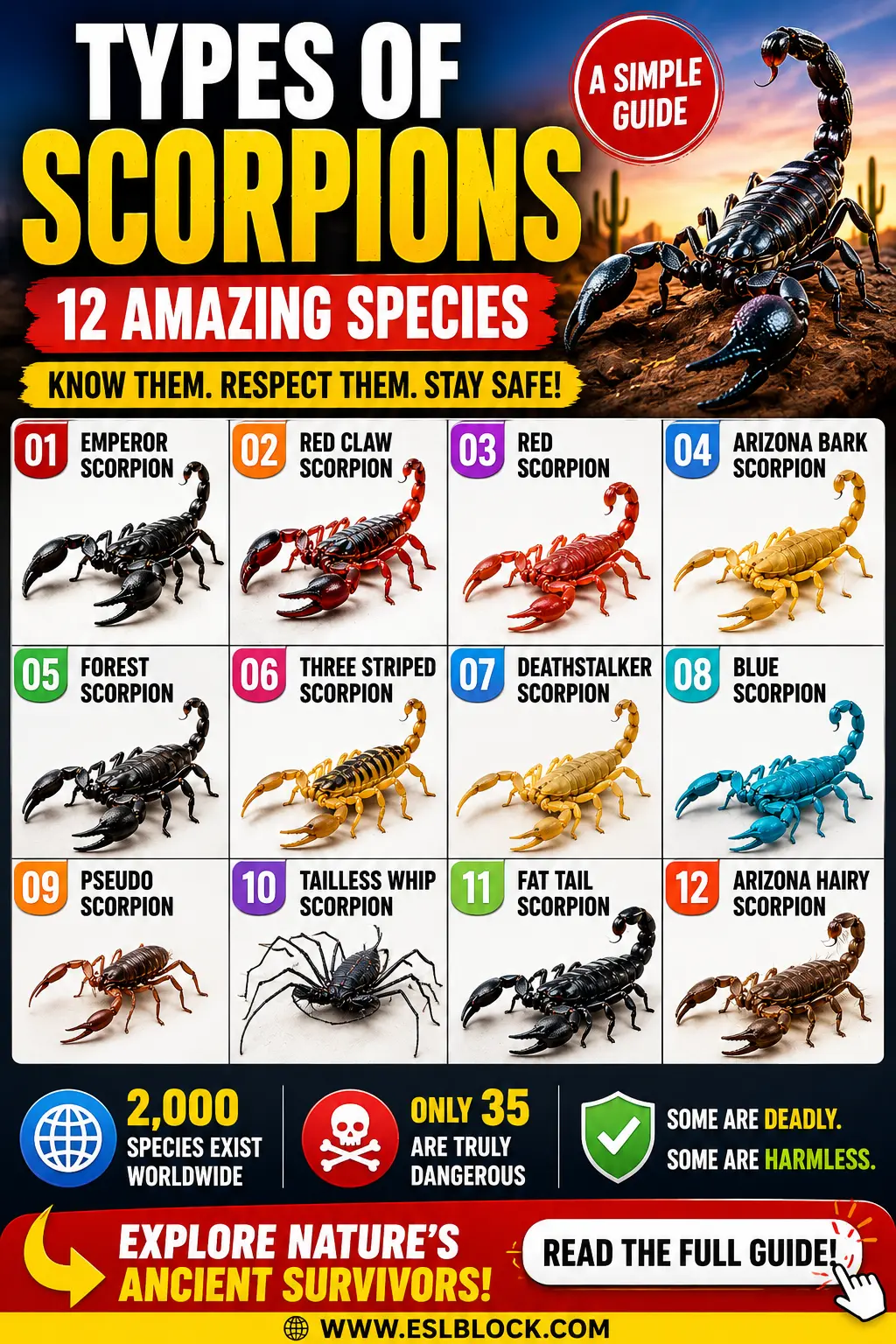
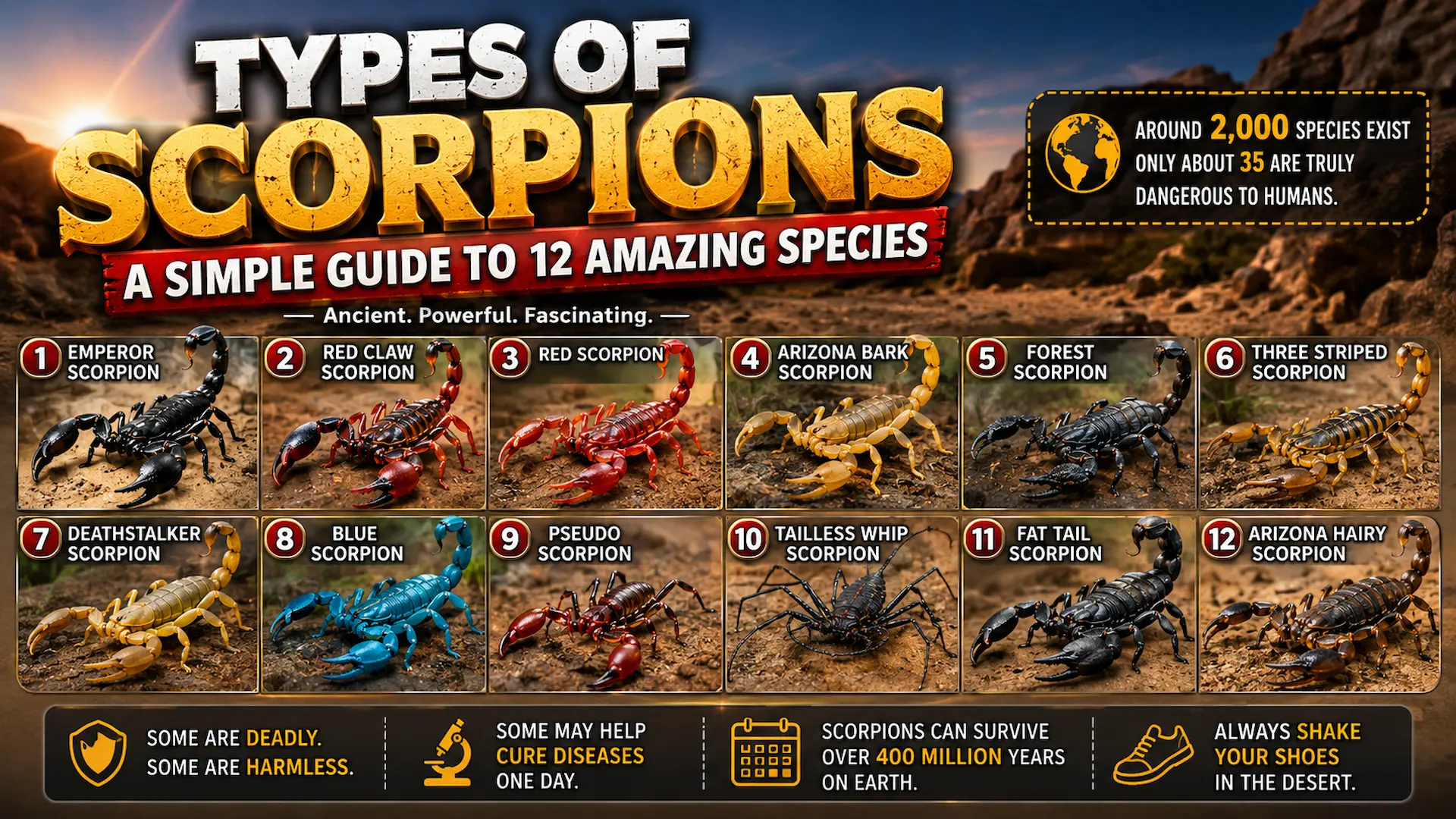
There are around 2,000 scorpion species on Earth. Only about 35 are truly dangerous to humans. Here are 12 types worth knowing about.
1. Emperor Scorpion
(Pronunciation: EM-per-er | From Latin imperator — “commander and ruler”)
Meet the big boss of scorpions.
It grows up to 20 cm long and has a shiny black body. But it is actually not dangerous at all. Its mild venom may even help treat some diseases.
Many people keep it as a pet. Native to West African rainforests, ancient traders reportedly encountered it along African trade routes for centuries.
2. Red Claw Scorpion
(Pronunciation: Red Claw | Named for its distinctively reddish-orange pincers)
This one looks a lot like the Emperor Scorpion. But it behaves very differently.
It is bold and more defensive. It uses powerful pincers to crush its prey. Its venom is mild and not dangerous to healthy humans unless an allergic reaction occurs.
Commonly found in African tropical forests, it was first documented by European naturalists in the 1800s.
3. Red Scorpion
(Pronunciation: Red SKOR-pee-un | From Latin scorpio, Greek skorpios — an ancient arachnid name)
Do not let the color fool you.
Small red scorpions are often the ones that cause the greatest health problems in humans. The Indian Red Scorpion is especially notorious across South Asia.
It has been feared in Indian villages for hundreds of years. Local folklore warned farmers to check their shoes every single morning before putting them on.
4. Arizona Bark Scorpion
(Pronunciation: air-ih-ZOH-nah Bark | Arizona from Spanish — possibly “small spring”)
Small but very dangerous.
Adults reach barely 3 inches with a yellowish translucent body. Its neurotoxin sting is extremely painful. Victims may feel numbness, vomiting, and a sensation like electricity passing through their body.
It is the most venomous scorpion in North America. It is especially dangerous to young children.
Arizona locals have passed down the habit of shaking out shoes and bedding for generations. It is just part of daily life there.
5. Forest Scorpion
(Pronunciation: FOR-est SKOR-pee-un | Forest from Old French forest — a large wooded land area)
This dark-colored scorpion loves cool and humid forests.
It is nocturnal and highly sensitive to disturbances. It hides under logs and leaf litter in tropical environments.
Its sting hurts but is rarely life-threatening. Forest scorpions have lived alongside rainforest wildlife for millions of years. They are still poorly studied compared to desert species.
6. Three Striped Scorpion
(Pronunciation: Three Striped | Named after the three visible stripes running along its back)
Easy to spot. Just look for those three stripes on its back.
This common scorpion is found across the United States and Northern Mexico. It does not grow longer than about 2.75 inches.
It has been a familiar sight in American Southwest homes and garages for as long as people have settled in those dry regions.
7. Deathstalker Scorpion
(Pronunciation: DETH-staw-ker | Modern English compound — named for its deadly, stealthy hunting style)
The name says everything.
The Deathstalker carries a powerful mix of neurotoxins. A sting is extremely painful but usually will not kill a healthy adult. Young children, elderly people, and those with heart conditions face much greater risk.
Here is the surprising part. Researchers found that a component of its venom called chlorotoxin may help treat brain tumors. This feared creature could actually save lives one day.
8. Blue Scorpion
(Pronunciation: Bloo SKOR-pee-un | Blue from Old English blēo — referring to its rare striking color)
This one is rare and genuinely beautiful.
Its blue color makes it stand out from every other scorpion on Earth. Scientists are studying its venom because early research suggests it may help treat serious illnesses including cancer.
Found mainly in Cuba and parts of Central America, the Blue Scorpion has been used in traditional folk medicine for many decades.
9. Pseudo Scorpion
(Pronunciation: SOO-doh SKOR-pee-un | Pseudo from Greek pseudos — meaning “false or fake”)
It looks like a scorpion. But it is not quite one.
Like all scorpions, it belongs to the arachnid family — eight legs, pincers, and sensory hairs. But the Pseudo Scorpion has no tail and no stinger at all. Totally harmless.
These tiny creatures have lived alongside humans in books and old wooden furniture for thousands of years. Most people never even notice them.
10. Tailless Whip Scorpion
(Pronunciation: TAYL-les Wip | Tailless from Old English — simply meaning “without a tail”)
This one looks like something from a nightmare. Long spidery legs. Flat body. Creepy appearance.
But here is the truth — it has zero venom. Completely harmless.
It is nocturnal and highly sensitive to movement around it. Ancient Egyptians actually depicted similar creatures in tomb artwork. They appear in several world mythologies as symbols of hidden danger.
11. Fat Tail Scorpion
(Pronunciation: Fat Tayl | Named for its noticeably thick and heavy tail section)
Do not be fooled by the funny name.
The Fat Tail Scorpion is very resistant to high temperatures. It also has aggressive behavior. It lives in hot African and Middle Eastern deserts.
It is considered one of the most dangerous scorpions on the continent. Bedouin tribes in North Africa have long feared this scorpion as a true symbol of desert danger.
12. Arizona Hairy Scorpion
(Pronunciation: air-ih-ZOH-nah HAIR-ee | Hairy from Old English hǣrig — covered in fine sensory bristles)
The largest scorpion in North America.
Tiny hairs cover its entire body. They act like sensors and can feel even the smallest movement nearby.
It is nocturnal and hides in dark cool spots during the day. Its sting is painful but not deadly for healthy adults. Despite its big size, it is actually one of the calmer species in the American Southwest.
Final Thoughts
Scorpions are ancient, tough, and honestly pretty fascinating.
They have survived on Earth for over 400 million years. They can even go without food for up to a year by simply slowing down their metabolism.
Some are deadly. Some are harmless. And some may help cure diseases one day. Just remember — always shake your shoes in the desert.