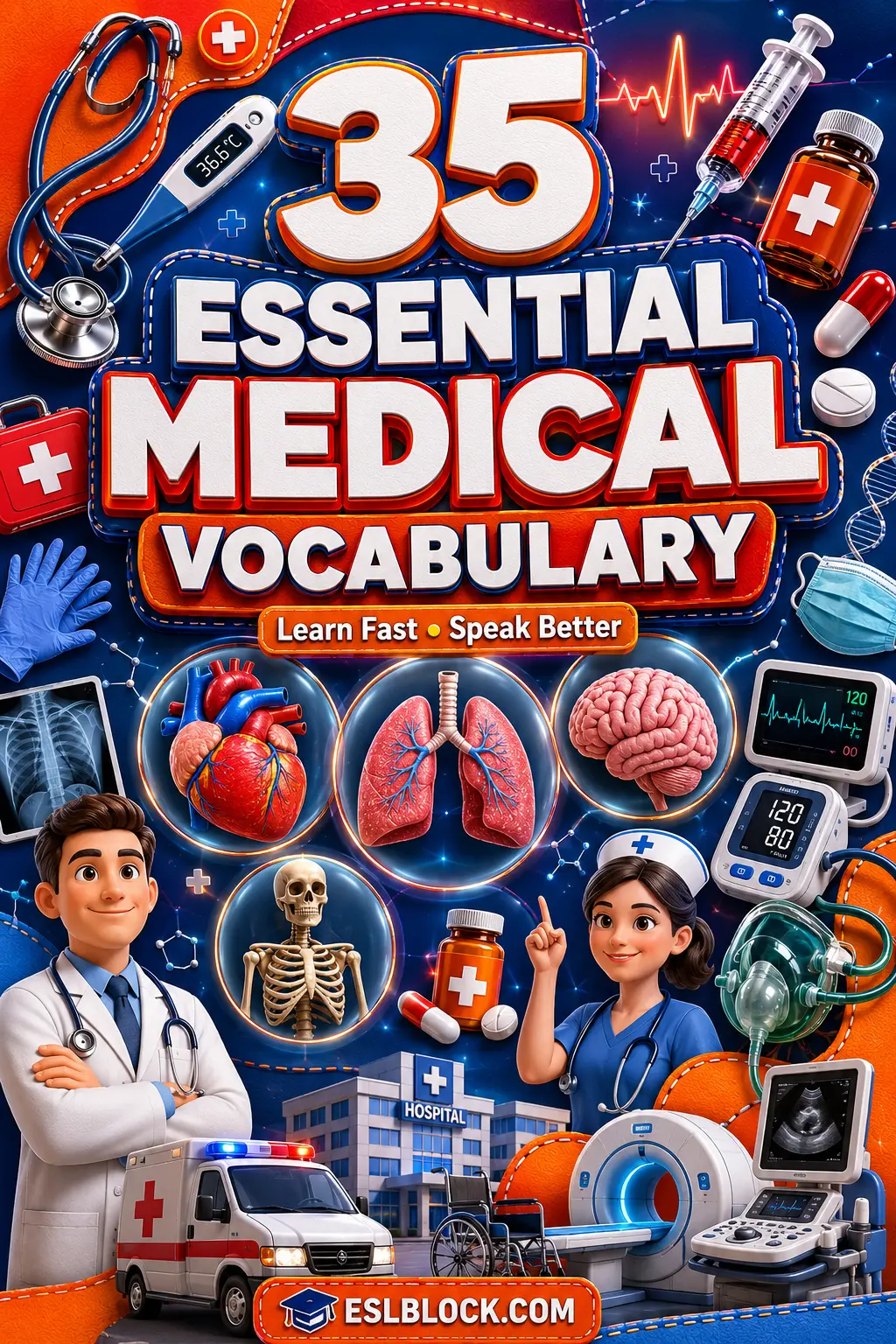
35 Medical Vocabulary Words You Need to Know Today
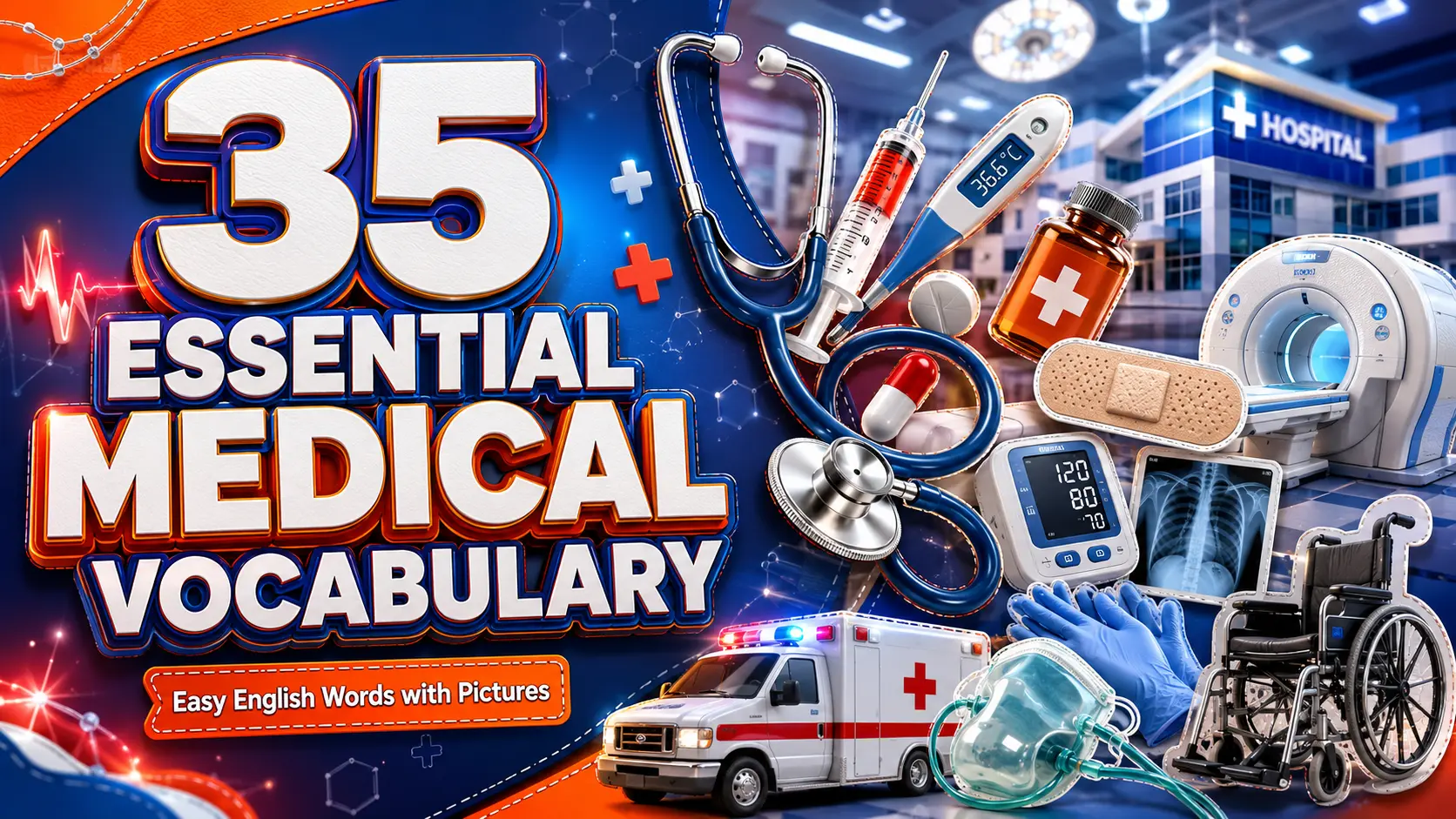
Doors flew open. Wheels squeaked fast. The blue heart monitor line flatlined instantly.
Tension filled the quiet hall. Silence followed. Every second counts when doctors fight to save lives.
Learning medical vocabulary helps you understand what happens when people get sick. It’s important to know the parts of speech for these words. Let’s look at 35 essential words.
1. Doctor
(Pronunciation: dok-tur | From the Latin word docere, which means to teach.)
A child often notice their bright white coat first. These experts use science to find why you are sick. They help you stay healthy always.
2. Nurse
(Pronunciation: nurs | Derived from the Latin word nutricia, meaning a person who nourishes.)
You will quickly see them check on you before anyone else in the hospital. They check heart rate and give medicine. Care never stops for them.
3. Surgeon
(Pronunciation: sur-jun | From Greek words meaning hand and work.)
A curious question: who actually cuts the body safely? These skilled experts perform major medical work. They fix insides carefully. Operations begin with them.
4. Dentist
(Pronunciation: den-tist | Rooted in the Latin word dens, meaning tooth.)
You might feel light movement inside your mouth here. They clean teeth or fill painful cavities. Every checkup improves smiles fast. Brush daily to avoid them.
5. Pharmacist
(Pronunciation: far-muh-sist | From the Greek word pharmakon, meaning drug or medicine.)
Ever noticed the long rows of white bottles behind their high counter? These professionals fill your prescriptions accurately. Advice and medicine are given here. They understand how drugs work.
6. Hospital
(Pronunciation: hos-pi-tul | Originates from the Latin hospes, meaning a guest or host.)
A quick action scene: ambulances arrive with screaming sirens outside this large building. Hundreds of workers care for very sick people inside. Help stays close at all hours. Lives are changed every day.
7. Clinic
(Pronunciation: klin-ik | Derived from the Greek klinē, meaning a bed.)
A tiny real-life moment: you check in here for your yearly checkup. They are smaller than massive hospitals. Appointments are needed always. Neighborhood health starts right here.
8. Ambulance
(Pronunciation: am-byuh-luns | From the French words that mean walking hospital.)
Red lights flash wildly as this fast white van rushes past traffic. Paramedics help severely injured people inside. It speeds toward doctors quickly. Every minute matters.
9. Stethoscope
(Pronunciation: steth-uh-skohp | Combined from Greek words for chest and to look at.)
The unique feel of cold metal always hits your chest first. The doctor listens to heart and lungs. It hears everything clearly. Your inner sounds start here.
10. Thermometer
(Pronunciation: thur-mom-uh-tur | Combined from Greek words for heat and measure.)
A tiny real-life moment: you hold this thin device carefully under your tongue. It measures the temperature of your body. Fever gets caught quickly. It checks how hot or cold you are.
11. Syringe
(Pronunciation: suh-rinj | From the Greek word for tube.)
Have you ever noticed how the bright light catches the sharp needle? Doctors use this clear tool to push liquid medicine inside. Shots don’t hurt for long. It moves stuff into your arm.
12. Bandage
(Pronunciation: ban-dij | Derived from Old French bande, meaning a strip.)
The cool transition happens when it covers up your bloody scraped knee. This white cloth wraps injuries tightly. It keeps cuts clean as they heal. Skin gets protected fast.
13. Medicine
(Pronunciation: med-ih-sun | Rooted in the Latin word medicus, which means physician.)
A surprising observation: this can be a small pink pill or a very nasty tasting liquid. Chemicals fix what is wrong inside you. Illness disappears completely. Your health improves right away.
14. Prescription
(Pronunciation: pree-skrip-shun | From the Latin for written before.)
A tiny real-life moment: the doctor hands you a little white piece of paper. You can use it only at the pharmacy. Medicine is listed there. You must give it to get pills.
15. Tablet
(Pronunciation: tab-lit | Originates from the Latin word meaning a small table or flat surface.)
Can you guess why these tiny white drugs are always so incredibly small? They are flat or round shapes that you swallow completely. They dissolve in the stomach quickly. Medicine works its way in.
16. Capsule
(Pronunciation: kap-sool | From the Latin word capsula, meaning a small box.)
A child notice the colorful plastic outside before anything else. It holds medicinal powder safely. You must swallow it with water always. It works slower than normal pills.
17. Injection
(Pronunciation: in-jek-shun | Originates from the Latin word for throwing in.)
A tiny real-life moment: you might squeeze your eyes tightly closed for the actual poke. It is a shot where liquids are pushed inside fast. Pain lasts only a second. Protection arrives with one tiny prick.
18. Vaccine
(Pronunciation: vak-seen | Named after vacca, the Latin word for cow.)
It’s often passive voice work for the body: you get given this protection against neurotoxins. It helps stop you from getting serious diseases later. Everyone stays safe from bad germs. It stops illness completely.
19. Blood Pressure Monitor
(Pronunciation: blud presh-ur mon-ih-tur | English word combination.)
The surprising sound of air rushing always happens next. The wide black cuff squeezes your upper arm tightly while it measures how hard blood pushes. Numbers appear quickly. Your heart health gets checked.
20. Wheelchair
(Pronunciation: weel-chair | Self-explanatory English compound.)
A tiny real-life moment: you might feel incredibly light when you sit inside. It has big black wheels. Movement helps you go anywhere easily. Help arrives on four wheels.
21. Crutches
(Pronunciation: kruch-iz | Originates from an Old English word associated with a staff.)
These long metal or wooden poles fit precisely under your arms. It supports you while a leg injury heals. Balance must be learned quickly. Movement returns step by step.
22. Oxygen Mask
(Pronunciation: ok-suh-jen mask | Combination of English words.)
The interesting feeling of warm rubber hits your nose next. It covers your mouth. Fresh air comes in instantly. Help breathes with you always.
23. Face Mask
(Pronunciation: fays mask | Basic English compound.)
You should always use natural language when describing how simple paper masks work. They cover mouth and nose completely to keep germs from rainforest wildlife or city crowds safe. Everyone breathes easy. Health stays protected.
24. Gloves
(Pronunciation: gluvz | Derived from an Old English word associated with hand.)
A child might notice the funny white color first. These thin blue or white barriers protect hands. Germs cannot spread through them. Doctors pull them on. Clean hands save many lives.
25. Hand Sanitizer
(Pronunciation: hand san-ih-ty-zur | Combination of English words.)
A child might notice first how incredibly cold it feels inside your hot palms. This gel or liquid kills germs instantly. No water is needed. Tiny bottles keep hands clean. Germs disappear quickly.
26. First Aid Kit
(Pronunciation: furst ayd kit | Combination of English words.)
A curious question: who always knows exactly where this bright red box is kept? It has medicine and small bandages. Emergency help starts right here. Little cuts are fixed.
27. X-ray
(Pronunciation: eks-ray | Named for the unknown “X” properties of the radiation.)
A quick action scene: the doctor pushes a large button while you hold your breath completely. This massive machine takes pictures of your dense white bones. It sees through skin fast. Inside pictures change everything.
28. MRI Scanner
(Pronunciation: em-ar-eye skan-ur | Abbreviation for Magnetic Resonance Imaging.)
An interesting sound of loud thumping always happens inside this massive white tube. Strong magnets check your internal organs carefully. It sees brain details perfectly. Your inside world gets photographed.
29. Ultrasound Machine
(Pronunciation: ul-truh-sound muh-sheen | Combination of English words.)
A tiny real-life moment: the cold clear gel always hits the skin next. It uses safe sound waves to see babies or internal body organs clearly. Pictures appear instantly. Seeing inside is possible.
30. Blood Test
(Pronunciation: blud test | English words.)
Doctors check results like they check how adjectives work: carefully. They take one small sample of your bright red blood to find hidden illness. Results change decisions fast. Health is measured perfectly.
31. Heart
(Pronunciation: hart | From an Old English word.)
The beautiful rhythm is constant always. This essential body pump moves red blood everywhere. It never stops beating. Life runs with every beat.
32. Lungs
(Pronunciation: lungz | Related to an old word for light.)
It’s often passive voice work for the body: you get given a deep breath automatically. These organs take fresh air inside. Oxygen reaches blood quickly. Breathing makes life work.
33. Brain
(Pronunciation: brayn | From an Old English word.)
A child might not notice this inside their own hard head. It controls every thought and movement perfectly. Knowledge starts right here. Thinking moves your entire world.
34. Skeleton
(Pronunciation: skel-uh-tun | From the Greek word for dried up.)
You see these bones at Halloween always. It supports your whole body inside. Everything attaches to it. Strength starts from within.
35. Patient
(Pronunciation: pay-shunt | Originates from the Latin word for suffering.)
A tiny real-life moment: you check in at the hospital desk for your doctor appointment. You are a suffering person who needs real care from nurses. Recovery starts right here. Help arrives for you.
Final Thoughts
Every single medical vocabulary word you just learned helps you stay safe and healthy. Which cool item or body part was your favorite?