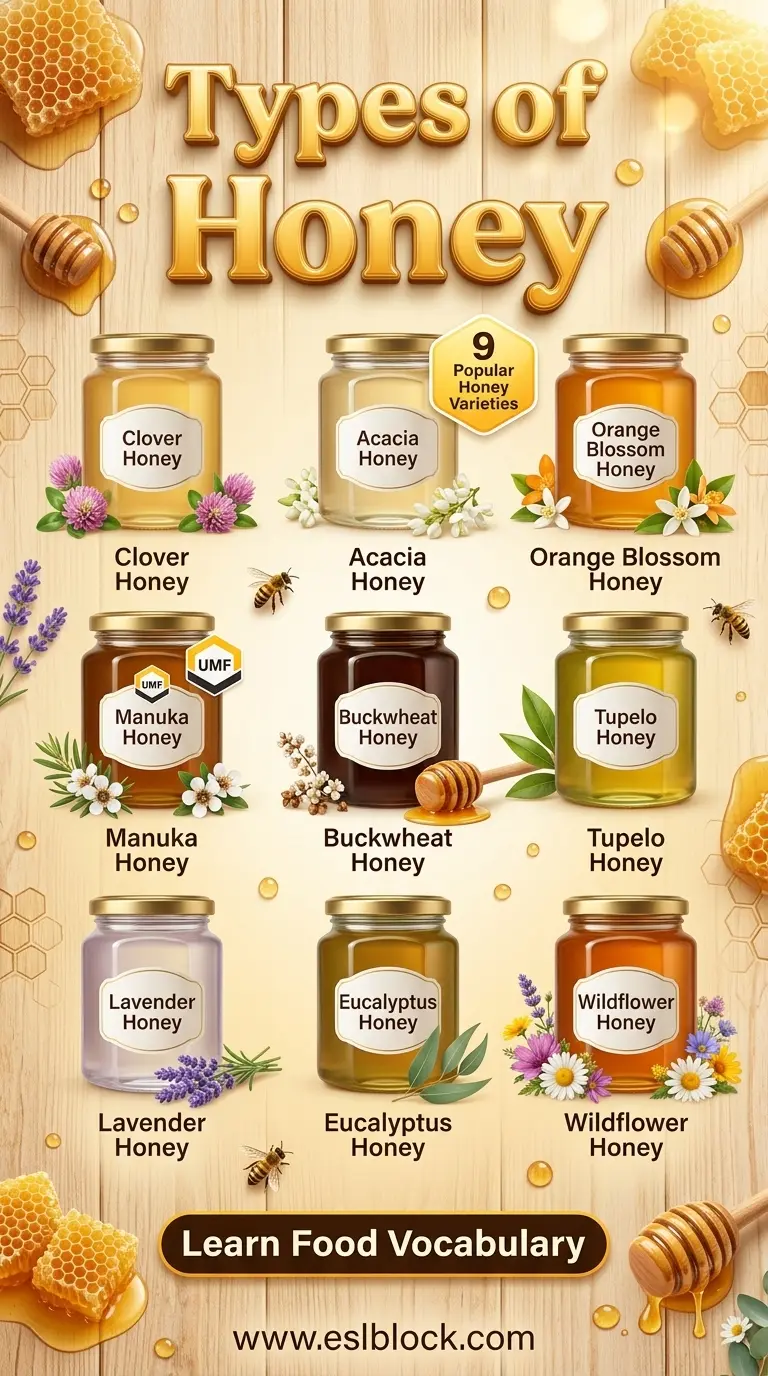
9 Popular Types of Honey You Should Know
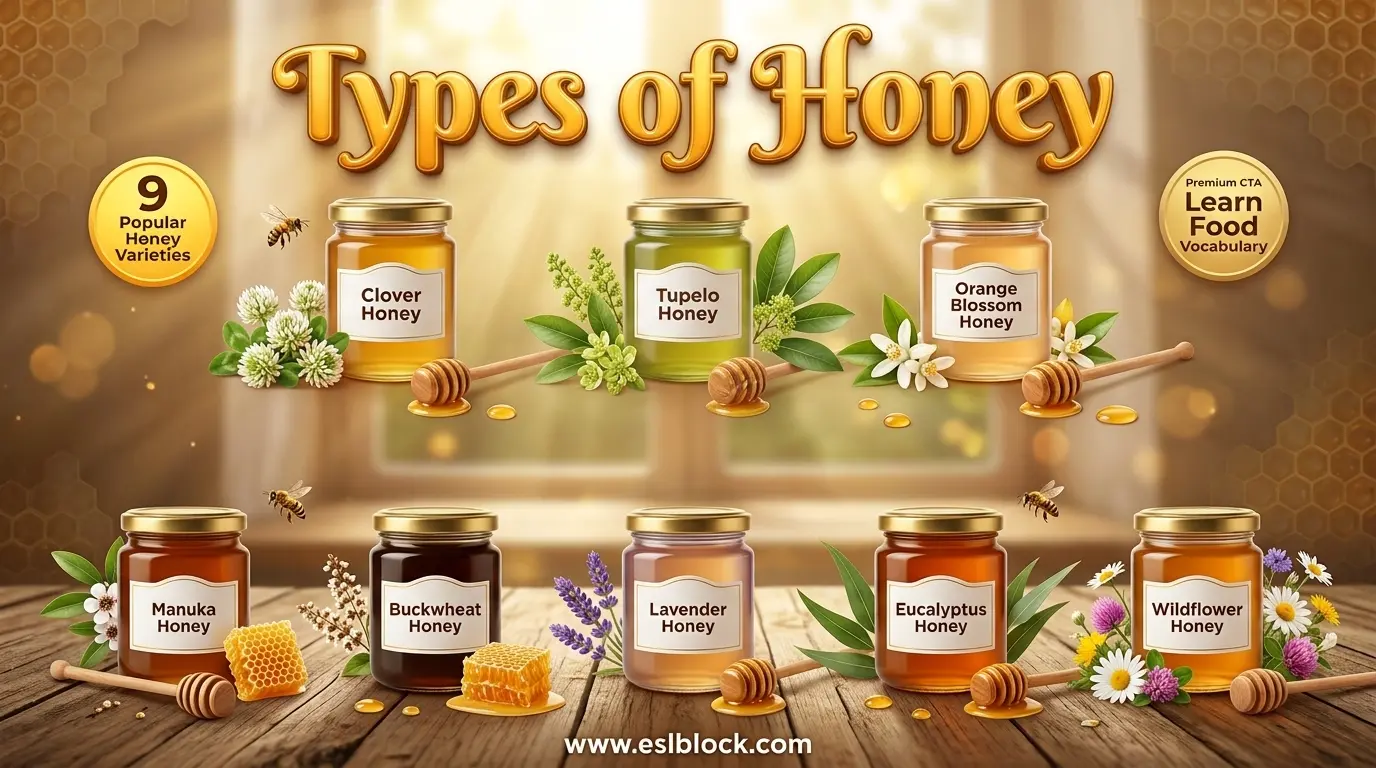
The jar caught the sunlight.
Golden. Thick. Sweet. It looked almost like liquid gold.
That’s the magic of honey. But here’s the thing… not all honey tastes the same. Bees collect nectar from different flowers, creating unique flavors, colors, and aromas. Let’s explore some of the world’s favorite honey varieties.
1. Clover Honey
(Pronunciation: KLOH-ver | Origin: Named after nectar collected from clover flowers, one of the world’s most common honey plants.)
If you’ve ever tasted honey, there’s a good chance it was Clover Honey. It’s the classic flavor many people grow up with.
This honey is light golden, mild, and wonderfully sweet. Bees visit white and red clover blossoms to produce it. The National Honey Board describes clover honey as one of the most popular table honeys in North America.
Simple sweetness never goes out of style.
2. Acacia Honey
(Pronunciation: Uh-KAY-shuh | Origin: Produced from the blossoms of black locust trees, often called acacia trees.)
Look closely. Acacia Honey is so clear that it almost sparkles inside the jar.
Its pale color and delicate floral taste make it a favorite for tea and desserts. Because it contains more natural fructose, it stays liquid longer than many other honeys. The Food and Agriculture Organization recognizes acacia as an important nectar source in many countries.
Clear. Light. Elegant.
3. Orange Blossom Honey
(Pronunciation: OR-inj BLOSS-um | Origin: Made from the nectar of blooming orange trees.)
Close your eyes for a second. It almost smells like walking through an orange orchard in spring.
Orange Blossom Honey has a fruity aroma with a gentle citrus flavor. It is commonly produced in regions where orange trees grow in large numbers. The beautiful fragrance comes from the orange blossom nectar collected by hardworking bees.
Every spoonful feels like spring.
4. Manuka Honey
(Pronunciation: Mah-NOO-kah | Origin: Produced from the flowers of the Manuka shrub native to New Zealand.)
Here’s the wild part. This honey has become famous all over the world for more than its sweet taste.
Manuka Honey is dark, rich, and produced only when bees gather nectar from Manuka flowers. It is often valued for its unique natural compounds. The New Zealand Ministry for Primary Industries carefully regulates authentic Manuka Honey.
Nature made it special.
5. Buckwheat Honey
(Pronunciation: BUCK-wheet | Origin: Made from the flowers of the buckwheat plant.)
Don’t be surprised by its color. Buckwheat Honey is much darker than most other varieties.
Its bold flavor and deep brown color make it stand out on any table. Many people enjoy it in baking or with warm drinks because of its rich taste. The United States Department of Agriculture notes that different nectar sources naturally produce different honey colors and flavors.
Dark doesn’t mean ordinary.
6. Tupelo Honey
(Pronunciation: TOO-puh-loh | Origin: Named after the white Tupelo trees that grow in the southeastern United States.)
Here’s something amazing. Tupelo Honey almost refuses to crystallize. Even after months in the jar, it often stays smooth and pourable.
This light golden honey has a buttery flavor with gentle floral notes. It is mainly produced in the swamps of Florida and Georgia, where bees gather nectar from blooming Tupelo trees. The National Honey Board recognizes Tupelo Honey as one of America’s premium honey varieties.
Smooth from the first drop to the last.
7. Lavender Honey
(Pronunciation: LAV-en-der | Origin: Produced from nectar collected from blooming lavender flowers.)
Open the lid, and the scent arrives before the taste. Soft. Floral. Relaxing.
Lavender Honey has a delicate flavor and a light golden color with gentle herbal notes. It is commonly produced in regions where lavender fields bloom each summer. The beautiful aroma comes from lavender blossoms that attract thousands of busy bees.
Sweetness with a peaceful touch.
8. Eucalyptus Honey
(Pronunciation: Yoo-kuh-LIP-tus | Origin: Made from nectar collected from eucalyptus tree flowers.)
The flavor is different right away. Rich. Slightly herbal. Easy to remember.
Eucalyptus Honey ranges from amber to dark brown and is popular in Australia, Spain, and other regions where eucalyptus trees grow naturally. Bees transform eucalyptus nectar into this distinctive honey with its bold taste.
Nature leaves its signature.
9. Wildflower Honey
(Pronunciation: WYLD-flow-er | Origin: Made from the nectar of many different wildflowers instead of a single flower species.)
No two jars are exactly alike. That’s what makes Wildflower Honey so interesting.
The color, taste, and aroma change with the seasons and the flowers blooming nearby. Every harvest tells a slightly different story because bees visit many kinds of blossoms. The Food and Agriculture Organization explains that floral diversity naturally influences honey flavor and color.
Every jar is a surprise.
If you enjoy learning food vocabulary, you may also like Types of Tomato and Chili Pepper Types. To build more everyday English, explore Parts of the Mouth Vocabulary and Body Parts Names in English.
Final Thoughts
Every jar of honey begins with thousands of tiny trips from flower to flower. The next time you taste honey, you might discover a new favorite simply by learning where the bees have been.