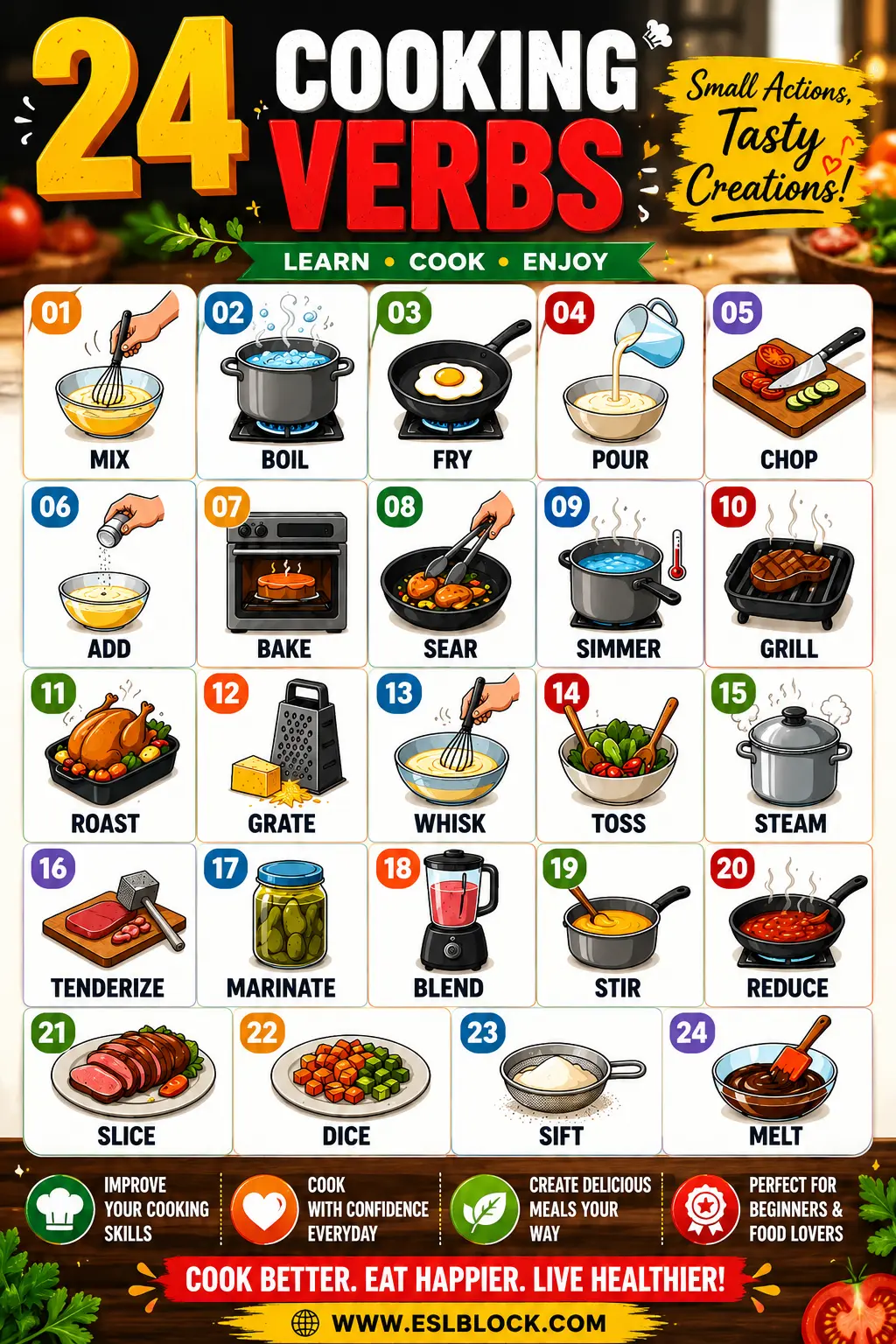
Cooking Verbs: Learn 24 Common Kitchen Action Words
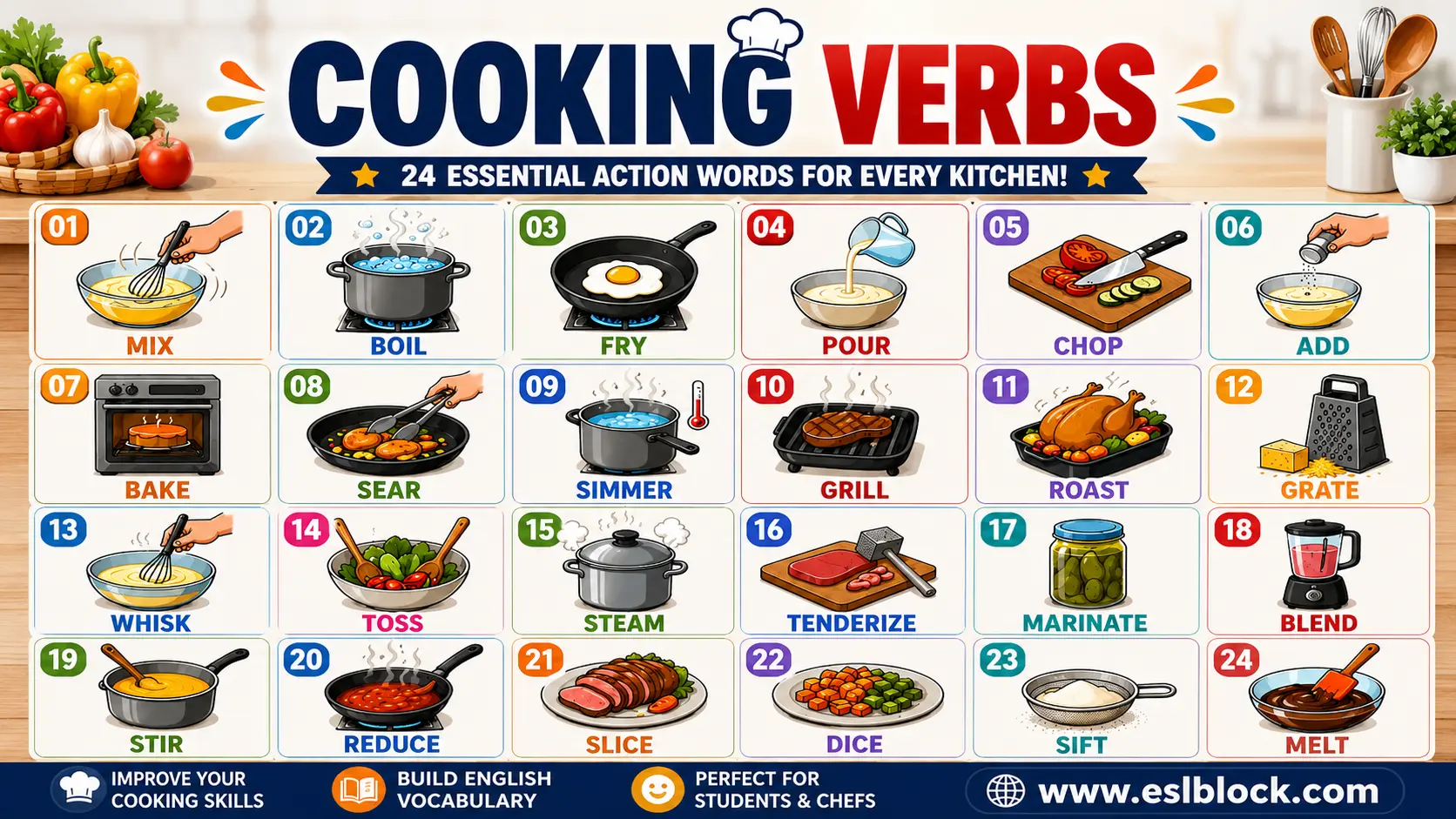
Cooking verbs help us describe what we do while preparing food. They make recipes easier to understand and improve your everyday English.
Whether you’re making breakfast or baking a cake, these action words appear in almost every recipe. Let’s learn twenty-four useful cooking verbs.
If you enjoy learning food vocabulary, you may also like our guide to types of tomato.
1. Mix
(Pronunciation: MIKS | Origin: From the Latin word meaning “to combine.”)
Mix means to combine two or more ingredients until they become one. You might mix flour, eggs, and milk before baking. Good mixing techniques help create smooth batter.
Everything starts together.
2. Boil
(Pronunciation: BOYL | Origin: From the Latin word meaning “to bubble.”)
Boil means to heat a liquid until it bubbles. Water boils before cooking pasta, rice, or vegetables.
Hot and bubbling.
3. Fry
(Pronunciation: FRY | Origin: An old English cooking word.)
Fry means to cook food in hot oil or butter. Eggs, potatoes, and fish are often fried. Different cooking methods use frying for crispy results.
Golden and crispy.
4. Pour
(Pronunciation: POR | Origin: From Old French meaning “to flow.”)
Pour means to let a liquid flow from one container into another. Milk, juice, or soup can all be poured carefully.
Slow and steady.
5. Chop
(Pronunciation: CHOP | Origin: An old English word meaning “to cut.”)
Chop means to cut food into medium-sized pieces using a knife. Vegetables are often chopped before cooking. Learning proper knife skills makes cooking safer.
Cut with care.
6. Add
(Pronunciation: AD | Origin: From Latin meaning “to put to.”)
Add means to put one ingredient into another. Recipes often tell you when to add sugar, salt, or spices.
Simple but important.
7. Bake
(Pronunciation: BAYK | Origin: An old English baking word.)
Bake means to cook food using dry heat inside an oven. Cakes, bread, and cookies are baked until golden.
The smell is wonderful.
8. Sear
(Pronunciation: SEER | Origin: From an old word meaning “to burn lightly.”)
Sear means to cook the outside of meat quickly over high heat. This helps lock in flavor before further cooking.
Brown is beautiful.
9. Simmer
(Pronunciation: SIM-er | Origin: From Middle English meaning “to gently boil.”)
Simmer means to cook just below the boiling point. Soups and sauces often simmer for a rich taste.
Slow cooking works.
10. Grill
(Pronunciation: GRIL | Origin: From French meaning “gridiron.”)
Grill means to cook food over direct heat. Many people enjoy grilled chicken, vegetables, and burgers. Outdoor barbecue cooking is popular around the world.
Smoky and delicious.
If you like learning everyday English, explore our article on body parts names.
11. Roast
(Pronunciation: ROHST | Origin: From Germanic languages.)
Roast means to cook food in an oven using dry heat. Chicken and potatoes are common roasted foods.
Perfect for family meals.
12. Grate
(Pronunciation: GRAYT | Origin: From Latin meaning “to scrape.”)
Grate means to rub food against a rough surface into small pieces. Cheese and carrots are often grated.
Tiny pieces. Big flavor.
13. Whisk
(Pronunciation: WISK | Origin: From an old word meaning “to move quickly.”)
Whisk means to beat ingredients quickly using a whisk. It adds air to eggs and cream.
Light and fluffy.
14. Toss
(Pronunciation: TOSS | Origin: An old English action word.)
Toss means to gently mix food by lifting and turning it. Salads are usually tossed before serving.
Fresh and colorful.
15. Steam
(Pronunciation: STEEM | Origin: Named after hot water vapor.)
Steam means to cook food using hot steam instead of oil. Vegetables stay colorful and healthy. Many healthy cooking methods recommend steaming.
Simple and nutritious.
16. Tenderize
(Pronunciation: TEN-duh-ryz | Origin: From the word “tender.”)
Tenderize means to make meat softer before cooking. A meat mallet or marinade is often used.
Softness matters.
17. Marinate
(Pronunciation: MAIR-uh-nayt | Origin: From Latin meaning “sea” because salt water was first used.)
Marinate means to soak food in a flavored liquid before cooking. It adds taste and tenderness.
Flavor begins early.
18. Blend
(Pronunciation: BLEND | Origin: From Old English meaning “to mix.”)
Blend means to mix ingredients until smooth using a blender. Smoothies and soups are often blended.
Smooth every time.
19. Stir
(Pronunciation: STUR | Origin: From Old English meaning “to move around.”)
Stir means to move ingredients around with a spoon while cooking. This helps food cook evenly.
Keep it moving.
20. Reduce
(Pronunciation: ri-DOOS | Origin: From Latin meaning “to make smaller.”)
Reduce means to cook a liquid until some of it evaporates. Sauces become thicker and richer.
Less becomes more.
21. Slice
(Pronunciation: SLYS | Origin: From Old French.)
Slice means to cut food into thin, even pieces. Bread, tomatoes, and meat are often sliced.
Thin is best.
22. Dice
(Pronunciation: DYS | Origin: Named after cube-shaped dice.)
Dice means to cut food into small cubes. Diced vegetables cook quickly and evenly.
Small cubes. Big difference.
23. Sift
(Pronunciation: SIFT | Origin: From Old English meaning “to separate.”)
Sift means to pass flour or sugar through a fine sieve. This removes lumps and adds air.
Smooth baking starts here.
24. Melt
(Pronunciation: MELT | Origin: From Old English meaning “to become liquid.”)
Melt means to change a solid into a liquid using heat. Butter and chocolate melt easily. Many baking basics explain when ingredients should be melted first.
Warm and ready.
Cooking verbs make recipes much easier to understand. The more you use these action words, the more confident you’ll become in the kitchen. Every delicious meal begins with a simple verb.