Homonyms in English: Learn Same Spelling, Different Meanings
It happened in a second. One tiny word. Two completely different meanings. That’s the fun of homonyms in English.
Picture this. Your friend says, “Let’s meet at the park.” Then someone else says, “Park the car.” Same word. Different idea. Pretty amazing, isn’t it?
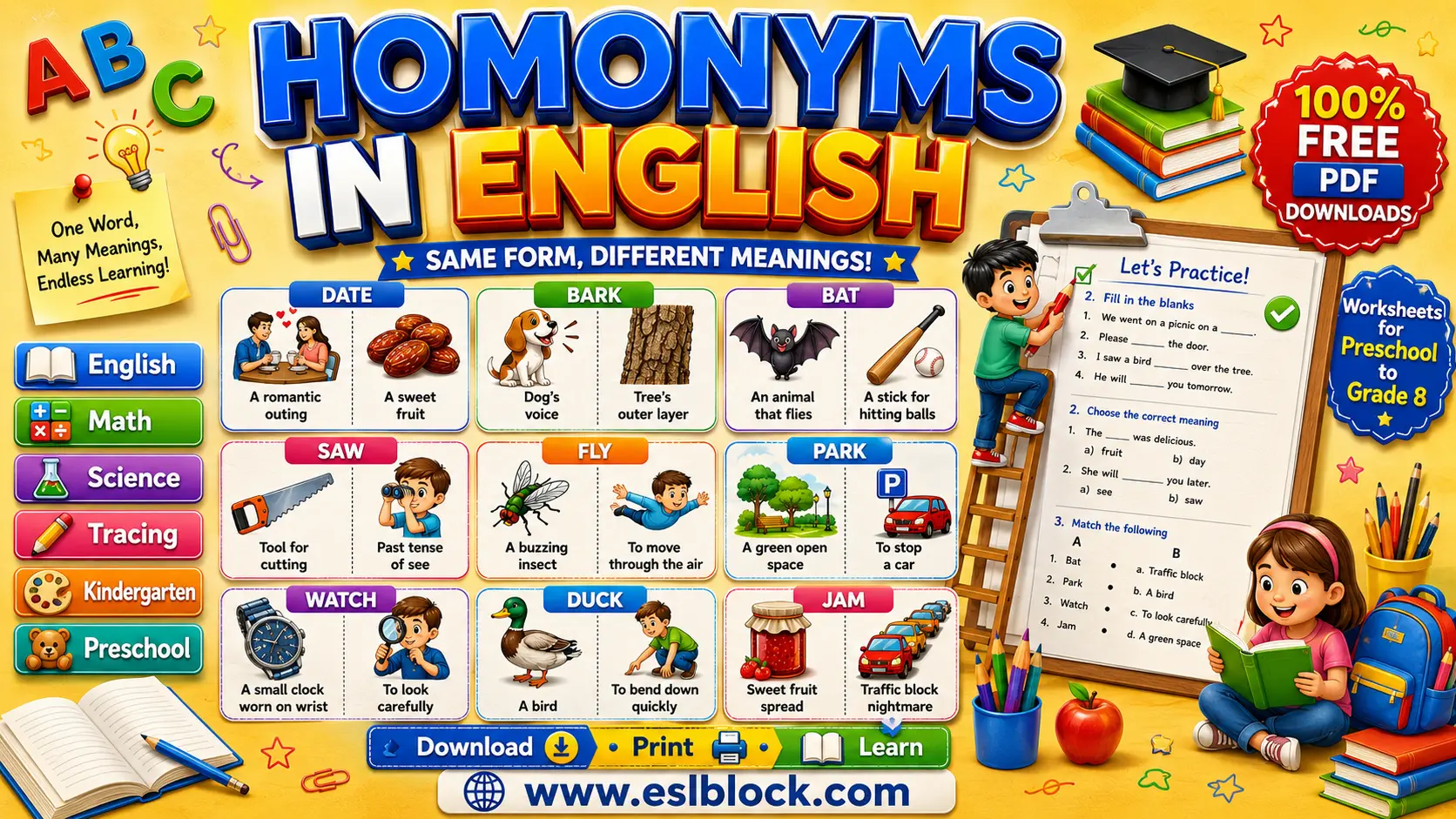
Homonyms are words that share the same spelling or pronunciation but have different meanings. They can make English exciting, confusing, and sometimes even funny. Once you start noticing them, you’ll find them everywhere.
Today we’ll explore some of the most common homonyms that appear in daily conversations.
If you’re building your English vocabulary, don’t miss our guides on Parts of the Hand, Parts of the Face, and Body Parts Names to strengthen your everyday English.
1. Date
(Pronunciation: dayt | From Latin “data,” meaning something given or recorded.)
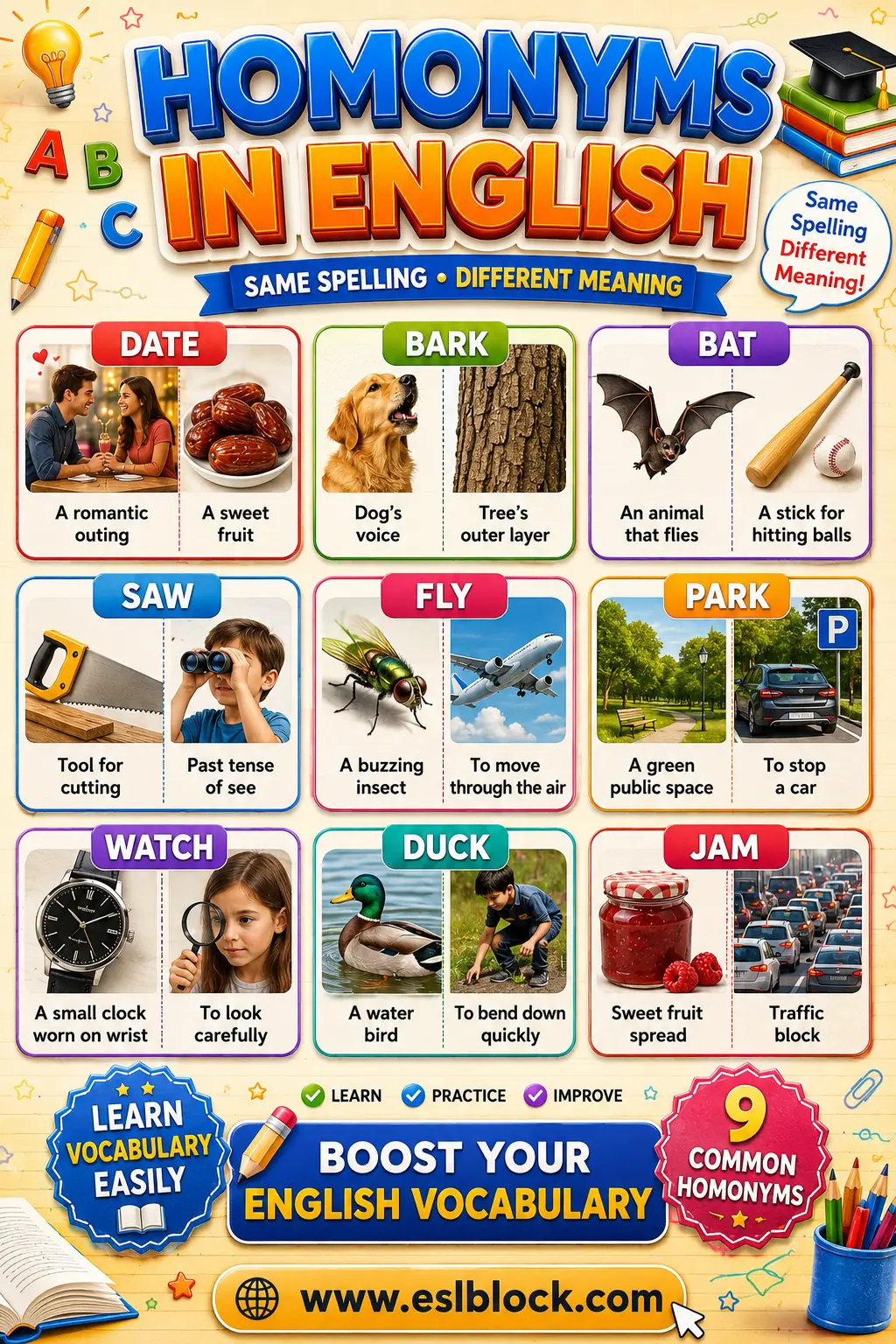
Imagine hearing someone say, “I have a date tonight.” Are they meeting someone special, or are they eating sweet dates? Only the sentence tells the story.
A date can be a planned meeting between two people. It can also be the sweet fruit that grows on date palm trees. The Cambridge Dictionary explains both meanings with helpful everyday examples.
One word. Two stories.
2. Bark
(Pronunciation: bark | From Old Norse and Old English words related to tree covering and loud sounds.)
A dog suddenly starts barking. Seconds later, you’re touching the rough bark of a tree. Strange? Not really.
Bark means the loud sound a dog makes. It also means the protective outer layer of a tree. Nature gave one word two very different jobs.
English loves surprises.
3. Bat
(Pronunciation: bat | From Old English “batt” and Scandinavian origins.)
Night falls. A bat flies across the sky. Later, children grab a baseball bat for a game.
One bat is a flying mammal. The other is sports equipment used to hit a ball. The spelling stays the same, but the picture in your mind changes completely.
Context changes everything.
4. Saw
(Pronunciation: saw | From Old English “sagu,” meaning a cutting tool.)
Someone says, “I saw a rainbow.” Then a carpenter picks up a saw. Same sound. Different meaning.
A saw can be the past tense of see. It is also a sharp tool used for cutting wood or metal. That’s why reading the whole sentence matters.
Every word tells a bigger story.
5. Fly
(Pronunciation: fly | From Old English “flēogan,” meaning to move through the air.)
A tiny fly lands on your lunch. A minute later, a bird begins to fly across the blue sky. Same word. Two different pictures.
A fly is a small winged insect. It also means to move through the air using wings or an aircraft. The sentence tells you which meaning is being used.
Small word. Big difference.
6. Park
(Pronunciation: park | From Old French “parc,” meaning an enclosed area.)
Children laugh while running through a green park. Outside, someone carefully parks a car beside the road.
A park can be a public place filled with trees, grass, and playgrounds. It can also mean to stop and leave a vehicle in a safe place. One word can describe both fun and careful driving.
Context is the real guide.
7. Watch
(Pronunciation: woch | From Old English “wæccan,” meaning to stay awake or observe.)
You glance at your watch to check the time. Then your teacher says, “Watch the board.” Same spelling. Different meaning.
A watch is a small clock worn on the wrist. It also means to look at something carefully or pay close attention. English often turns nouns into verbs.
That’s what makes learning fun.
8. Duck
(Pronunciation: duk | From Old English “duce,” referring to the bird.)
A duck swims peacefully across the pond. Suddenly someone shouts, “Duck!” Everyone quickly bends down.
A duck is a water bird with a flat bill. It also means to lower your head or body quickly to avoid being hit. One word can describe an animal or a quick action.
Quick thinking helps.
9. Jam
(Pronunciation: jam | From Old French “jamber,” later linked with pressing tightly together.)
You spread strawberry jam on warm toast. Later, traffic comes to a complete jam during rush hour.
Jam is a sweet spread made from fruit and sugar. It also means a situation where people or vehicles become tightly packed together. The Collins Dictionary explains both meanings with practical examples.
English is full of surprises.
Every time you learn a new homonym, you unlock another little mystery in English. Keep reading, keep listening, and soon you’ll spot these clever words everywhere. That’s when vocabulary becomes an adventure.
Keep exploring new vocabulary, and don’t forget to check out our guides on Parts of the Mouth, Parts of the Brain, Parts of the Heart, and Names of Teeth in English. Every new word makes your English a little stronger.