12 Types of Donkeys You Should Know with Pictures
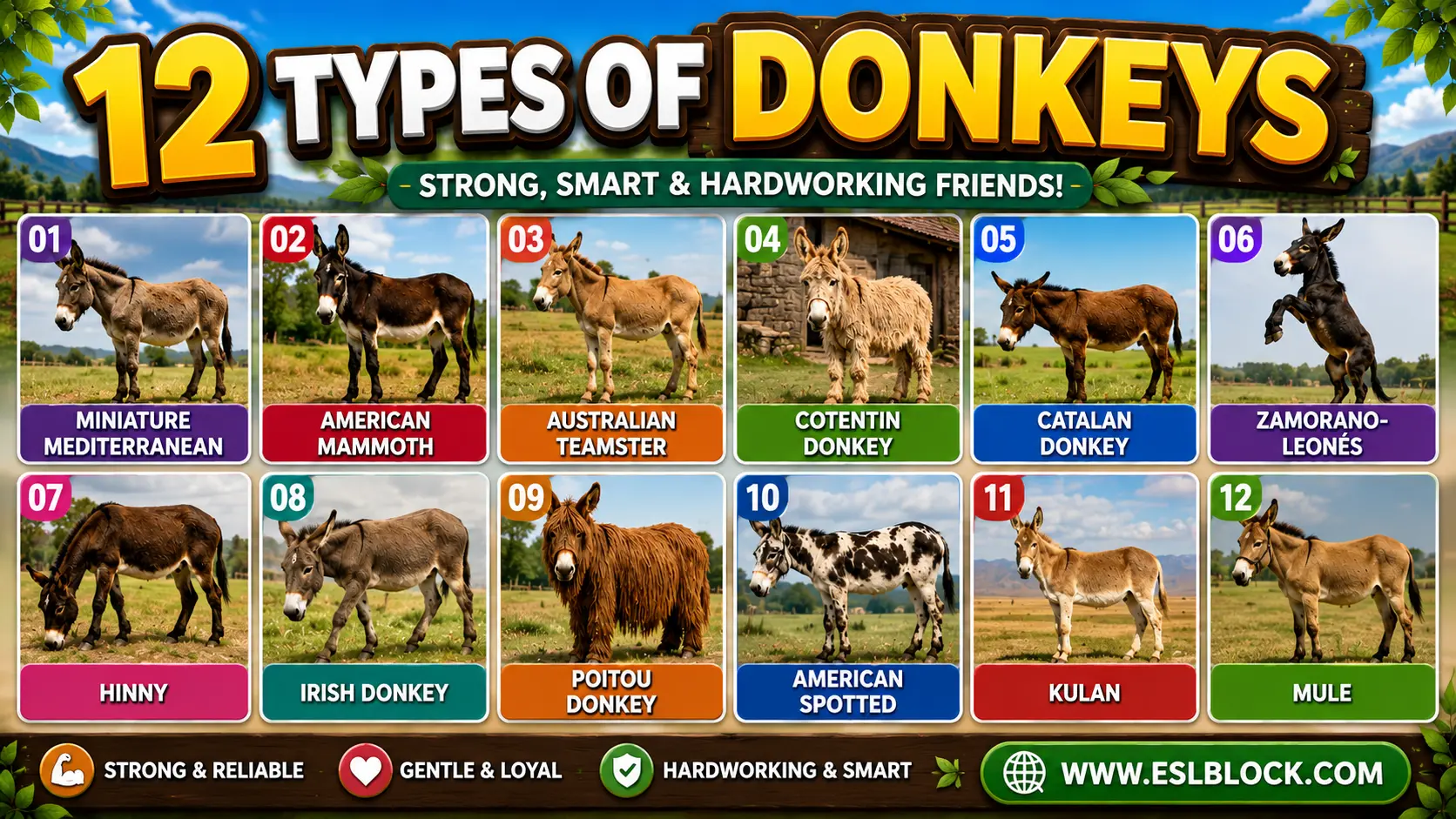
Types of donkeys are found in many parts of the world. Some help farmers with heavy work, while others are kept as friendly companion animals.
Donkeys are intelligent, hardworking, and gentle. Let’s meet twelve interesting donkey types and discover what makes each one special.
If you enjoy learning animal vocabulary, you may also like our guide to parts of a dog.
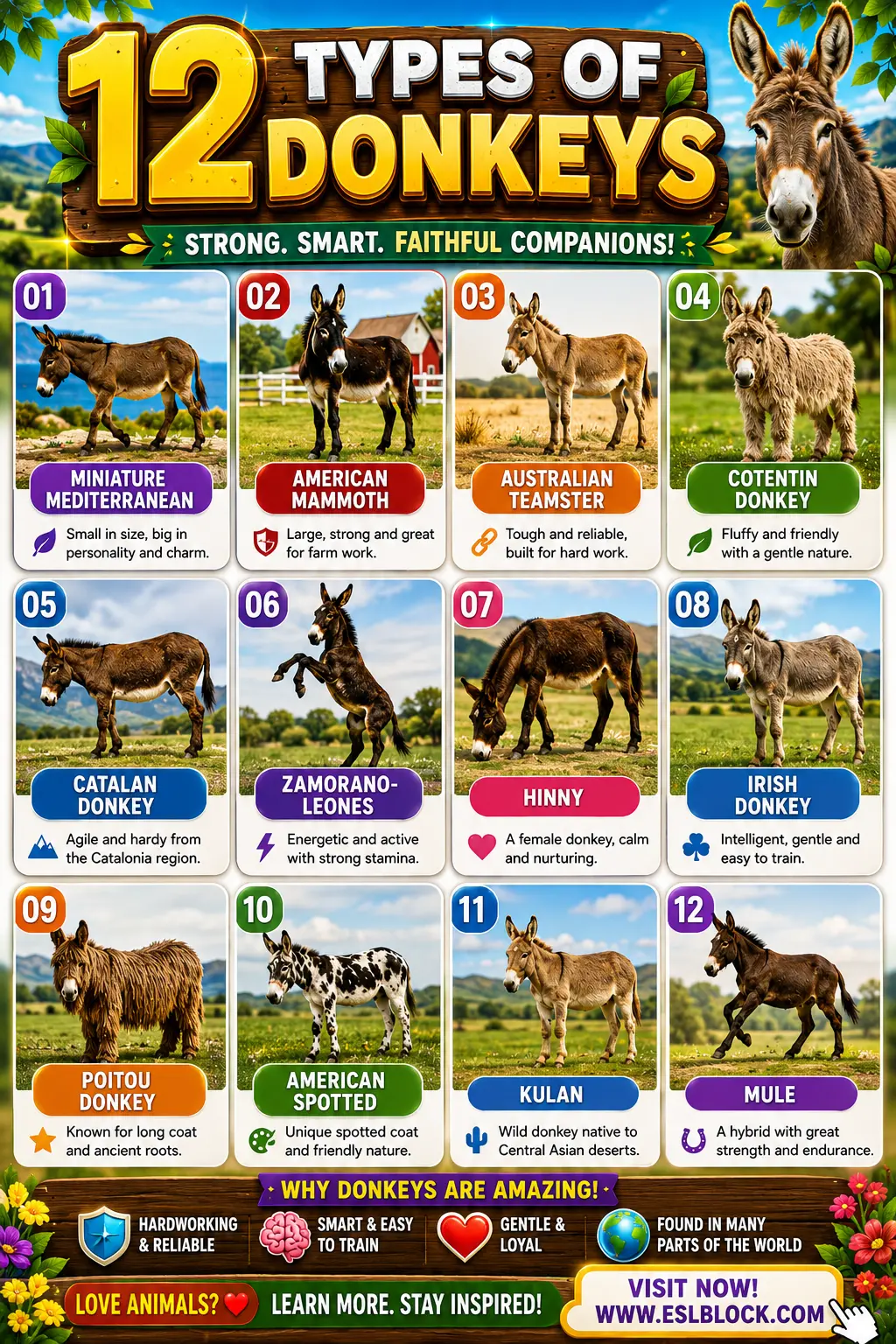
1. Miniature Mediterranean
(Pronunciation: MIN-ee-uh-cher MED-uh-tuh-RAY-nee-un | Origin: Developed from small donkeys around the Mediterranean Sea.)
The Miniature Mediterranean Donkey is one of the smallest donkey breeds. It is gentle, playful, and often kept as a family pet. Many owners enjoy these friendly companion animals because they are easy to handle.
Tiny size. Huge personality.
2. American Mammoth
(Pronunciation: uh-MAIR-ih-kun MAM-uth | Origin: Developed in the United States during the 1800s.)
The American Mammoth is one of the largest donkey breeds in the world. It was bred to produce strong mules and help with heavy farm work.
Built for strength.
3. Australian Teamster
(Pronunciation: aw-STRAY-lee-un TEEM-ster | Origin: Developed for transport work in Australia.)
Australian Teamster donkeys are known for their strength and calm behavior. They were once widely used to carry supplies across rough land.
Reliable every day.
4. Cotentin Donkey
(Pronunciation: koh-TON-tan DON-kee | Origin: Native to Normandy, France.)
The Cotentin Donkey has a soft gray coat and friendly nature. Farmers have valued this breed for centuries. Today, many heritage livestock breeds are protected to preserve their history.
Quiet and dependable.
5. Catalan Donkey
(Pronunciation: KAT-uh-lan DON-kee | Origin: Native to Catalonia, Spain.)
Catalan Donkeys are tall, muscular, and very strong. They have helped farmers with plowing and pulling carts for generations.
Power with patience.
6. Zamorano-Leonés
(Pronunciation: zah-moh-RAH-noh lay-oh-NAYS | Origin: Native to northwestern Spain.)
The Zamorano-Leonés Donkey is famous for its dark coat and large body. It is considered a rare breed that needs careful protection.
Rare but remarkable.
7. Hinny
(Pronunciation: HIN-ee | Origin: A cross between a male horse and a female donkey.)
A Hinny looks similar to a small horse but inherits qualities from both parents. It is calm, intelligent, and hardworking.
A unique family member.
8. Irish Donkey
(Pronunciation: EYE-rish DON-kee | Origin: Native to Ireland.)
Irish Donkeys have thick coats that help them stay warm in cool weather. They are gentle animals often found on small farms.
Made for cool climates.
9. Poitou Donkey
(Pronunciation: PWAH-too DON-kee | Origin: Native to western France.)
The Poitou Donkey is easy to recognize because of its long, shaggy coat. It is one of the rarest donkey breeds in the world. Conservation groups work to protect this endangered breed.
Its coat steals the show.
If you enjoy learning about living things, explore our guide to human body organs.
10. American Spotted
(Pronunciation: uh-MAIR-ih-kun SPOT-id | Origin: Developed in the United States.)
The American Spotted Donkey has beautiful black or brown spots across its body. Its colorful appearance makes it popular on hobby farms.
Beauty meets kindness.
11. Kulan
(Pronunciation: koo-LAHN | Origin: A wild donkey native to Central Asia.)
The Kulan is a wild donkey that lives in deserts and grasslands. It runs quickly to escape danger and survives in dry environments. Wildlife experts support wild equid conservation to protect this remarkable animal.
Fast and fearless.
12. Mule
(Pronunciation: MYOOL | Origin: A cross between a male donkey and a female horse.)
Mules are famous for their strength, intelligence, and sure-footed nature. They have helped people carry heavy loads for thousands of years. Their excellent working ability makes them valuable around the world.
Strong. Smart. Steady.
Donkeys have been trusted partners of people for thousands of years. Every type has its own story, personality, and special skills. The more you learn about donkeys, the more you’ll admire these amazing animals.