
Verb Tenses: 12 English Tenses with Charts and Examples

Verb tenses tell us when an action happens: in the past, in the present or in the future. They also show whether the action is finished, still in progress, or repeated. English has 12 main verb tenses, and this guide explains each one with a simple formula, a timeline and correct example sentences.
You don’t need to know grammar names to speak English well. Many fluent speakers couldn’t tell you what the “past perfect” is. But knowing how the tenses work helps you understand what you read and hear, write clearly and avoid common mistakes. When you’ve finished, test yourself with our free tenses quiz.
What Are Verb Tenses?
A verb tense is the form of a verb that shows the time of an action or state. There are three times: the present, the past and the future. Each time can be expressed in four ways, called aspects:
- Simple: facts, habits and single finished actions
- Continuous (progressive): actions in progress
- Perfect: actions completed before a certain time
- Perfect continuous: actions that continue up to a certain time
Three times multiplied by four aspects gives us the 12 tenses.
Strictly speaking, English verbs change their form for only two tenses: the present (play, plays) and the past (played). The future and the other forms are built with helping verbs such as will, be and have. Most English courses still teach them as 12 tenses, and so do we.
The 12 English Verb Tenses at a Glance
This chart shows all 12 tenses with their formulas and the verb play. Past tenses are in blue, present tenses in green and future tenses in red.
PAST
PRESENT
FUTURE
Past · SimpleSimple Past
verb-ed / V2I played.Present · SimpleSimple Present
base verb (+s)I play. She plays.Future · SimpleSimple Future
will + base verbI will play.Past · ContinuousPast Continuous
was/were + verb-ingI was playing.Present · ContinuousPresent Continuous
am/is/are + verb-ingI am playing.Future · ContinuousFuture Continuous
will be + verb-ingI will be playing.Past · PerfectPast Perfect
had + V3I had played.Present · PerfectPresent Perfect
have/has + V3I have played.Future · PerfectFuture Perfect
will have + V3I will have played.Past · Perfect ContinuousPast Perfect Continuous
had been + verb-ingI had been playing.Present · Perfect ContinuousPresent Perfect Continuous
have/has been + verb-ingI have been playing.Future · Perfect ContinuousFuture Perfect Continuous
will have been + verb-ingI will have been playing.Here are the same 12 tenses in one sentence, so you can compare them side by side:
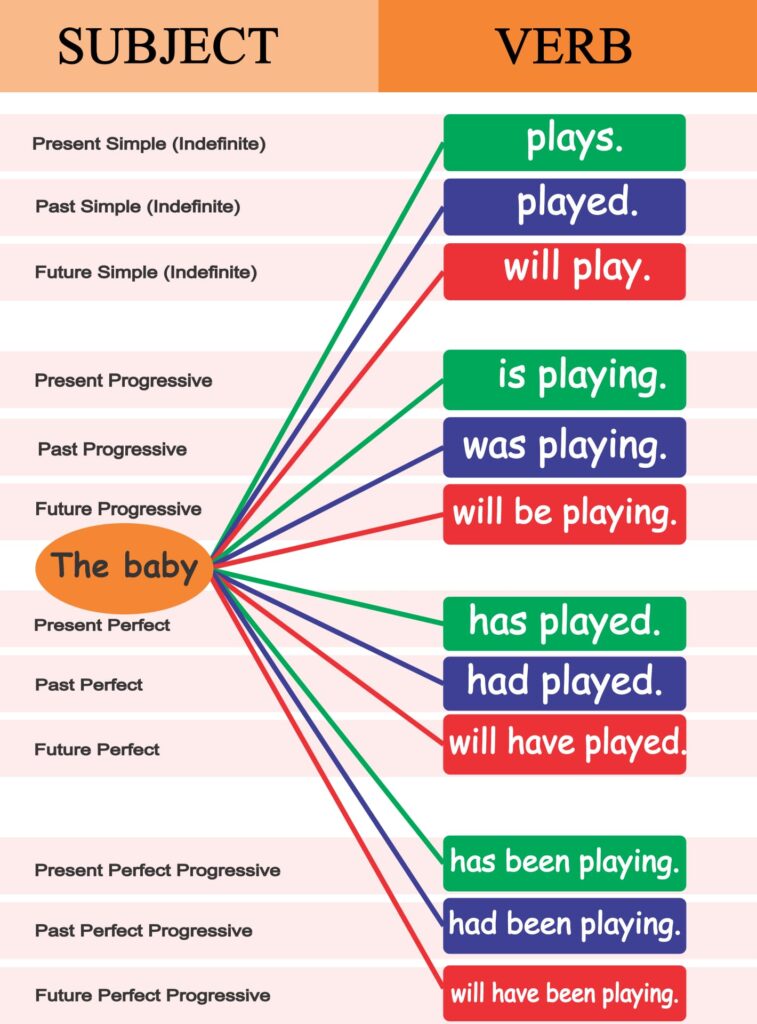
Key to the formulas: base verb = play, go; V2 = past form (played, went); V3 = past participle (played, gone); verb-ing = present participle (playing, going).
Simple Tenses
The three simple tenses describe facts, habits and single actions. They don’t tell us whether an action is finished or still in progress. That makes them the easiest tenses to learn, so most learners start here.
1. Simple Present Tense
The simple present describes habits, routines, facts and things that are generally true.
Use the simple present for:
- habits and routines: I walk to school.
- facts and general truths: Water boils at 100°C.
- permanent situations: She lives in Lahore.
- timetables and schedules: The train leaves at 7 a.m.
How to Form the Simple Present
| Form | Structure | Example |
|---|---|---|
| Positive | Subject + base verb (+ -s/-es with he, she, it) | She plays tennis. |
| Negative | Subject + do/does not + base verb | She does not play tennis. |
| Question | Do/Does + subject + base verb? | Does she play tennis? |
Signal words: always, usually, often, sometimes, never, every day, on Mondays
Simple Present Example Sentences
- They go to school every day.
- I play football after school.
- Every Sunday, we eat spaghetti for dinner.
- Sophia walks to school every morning.
- The Moon goes around the Earth.
- William drives a taxi.
- She does not drink coffee.
- Do you live in Sydney?
Learn more in our full guide to the simple present tense.
2. Simple Past Tense
The simple past describes actions and situations that started and finished at a specific time in the past.
Use the simple past for:
- finished actions: I visited my grandmother last week.
- a series of past actions: She woke up, had breakfast and left.
- past habits: We played outside every evening when we were children.
How to Form the Simple Past
| Form | Structure | Example |
|---|---|---|
| Positive | Subject + past form (V2) | She played tennis. |
| Negative | Subject + did not + base verb | She did not play tennis. |
| Question | Did + subject + base verb? | Did she play tennis? |
Regular verbs add -ed (play → played), sometimes with a spelling change (stop → stopped, study → studied). Irregular verbs have their own past forms, such as go → went and eat → ate.
Signal words: yesterday, last week, two days ago, in 2020, when I was young
Simple Past Example Sentences
- She ran to catch the bus yesterday.
- I played cricket last winter.
- We traveled to France in 2024.
- Mia lost her keys this morning.
- They watched TV last night.
- Sophia did not go to school on Monday.
- Did you see that dog?
- Did you play football last week?
Learn more in our full guide to the simple past tense.
3. Simple Future Tense
The simple future describes actions that will happen after now.
Use the simple future for:
- predictions: It will rain tomorrow.
- decisions made while speaking: I’ll answer the phone.
- promises and offers: I will help you.
- future facts: She will be ten next month.
How to Form the Simple Future
| Form | Structure | Example |
|---|---|---|
| Positive | Subject + will + base verb | She will play tennis. |
| Negative | Subject + will not (won’t) + base verb | She will not play tennis. |
| Question | Will + subject + base verb? | Will she play tennis? |
Shall is mainly used with I and we for offers and suggestions (Shall we start?). For plans you have already made, English often uses be going to: I’m going to visit Paris next summer. Both will and shall are modal verbs.
Signal words: tomorrow, next week, soon, later, in 2030
Simple Future Example Sentences
- She will call you tomorrow.
- I don’t think I’ll buy that bike.
- They will celebrate their anniversary in Washington.
- We will not come to the party.
- Will he arrive soon?
- When will they leave?
- I’ll help you with your homework.
- Shall we start now?
Learn more in our full guide to the simple future tense.
Continuous (Progressive) Tenses
The continuous tenses, also called progressive tenses, describe actions that are in progress at a certain time. They all use a form of be + verb-ing. Verbs that describe states, such as know, like and want, are not normally used in continuous tenses. Learn more about stative verbs.
4. Present Continuous Tense
The present continuous (also called the present progressive) describes actions happening now or around now.
Use the present continuous for:
- actions happening right now: I am reading.
- temporary situations: He is staying with his aunt this month.
- future arrangements: We are flying to Dubai on Friday.
- annoying habits, with always: He is always losing his keys.
How to Form the Present Continuous
| Form | Structure | Example |
|---|---|---|
| Positive | Subject + am/is/are + verb-ing | She is playing tennis. |
| Negative | Subject + am/is/are not + verb-ing | She is not playing tennis. |
| Question | Am/Is/Are + subject + verb-ing? | Is she playing tennis? |
Signal words: now, right now, at the moment, today, this week, Look!, Listen!
Present Continuous Example Sentences
- William is eating a cake.
- Amelia is swimming in the river.
- They are painting the door.
- I am watching a movie right now.
- The car is going very slowly.
- She is still sleeping.
- We are moving to New York this winter.
- Are you listening to me?
Learn more in our full guide to the present continuous tense.
5. Past Continuous Tense
The past continuous (past progressive) describes an action that was in progress at a certain time in the past.
Use the past continuous for:
- an action in progress at a past time: At 8 p.m., I was cooking.
- an action interrupted by another (with when): I was sleeping when the phone rang.
- two actions happening at the same time (with while): She was reading while he was cooking.
- background details in stories: The sun was shining and birds were singing.
How to Form the Past Continuous
| Form | Structure | Example |
|---|---|---|
| Positive | Subject + was/were + verb-ing | She was playing tennis. |
| Negative | Subject + was/were not + verb-ing | She was not playing tennis. |
| Question | Was/Were + subject + verb-ing? | Was she playing tennis? |
Signal words: while, when, at 8 o’clock last night, all day yesterday
Past Continuous Example Sentences
- She was studying the report at 9 p.m.
- William was baking a cake when the storm started.
- You were painting the fence all morning.
- He was writing an email when I called.
- I was preparing dinner while Mia was working upstairs.
- It was raining when we left the house.
- We were not watching TV.
- Were they talking during the lesson?
Learn more in our full guide to the past continuous tense.
6. Future Continuous Tense
The future continuous (future progressive) describes an action that will be in progress at a certain time in the future.
Use the future continuous for:
- an action in progress at a future time: At noon tomorrow, I will be flying to Rome.
- expected future events: The team will be playing in the final next week.
- polite questions about plans: Will you be using the car tonight?
How to Form the Future Continuous
| Form | Structure | Example |
|---|---|---|
| Positive | Subject + will be + verb-ing | She will be playing tennis. |
| Negative | Subject + will not be + verb-ing | She will not be playing tennis. |
| Question | Will + subject + be + verb-ing? | Will she be playing tennis? |
Signal words: at this time tomorrow, at 8 p.m. tonight, next week, soon
Future Continuous Example Sentences
- At 8 p.m. tonight, I will be watching the match.
- This time next week, we will be relaxing on the beach.
- Will they be flying over the sea at midnight?
- Amelia will not be coming home tonight.
- She will be studying at university next year.
- The plane will not be landing on time.
- Will you be using the computer later?
- By 2040, many people will be driving electric cars.
Learn more in our full guide to the future continuous tense.
Perfect Tenses
The perfect tenses connect two points in time. They show that an action was completed before a certain moment in the past, present or future. They all use a form of have + the past participle (V3).
7. Present Perfect Tense
The present perfect connects the past with now. It talks about past actions when the exact time is not important, or about situations that started in the past and continue now.
Use the present perfect for:
- life experiences, with ever and never: Have you ever been to London?
- recent actions with a result now: I have lost my keys.
- situations continuing until now, with for and since: We have lived here since 2019.
- an unfinished time period: She has called me twice today.
How to Form the Present Perfect
| Form | Structure | Example |
|---|---|---|
| Positive | Subject + have/has + past participle (V3) | She has played tennis. |
| Negative | Subject + have/has not + V3 | She has not played tennis. |
| Question | Have/Has + subject + V3? | Has she played tennis? |
Don’t use the present perfect with a finished time such as yesterday or last year. Say I saw him yesterday, not I have seen him yesterday.
Signal words: ever, never, already, yet, just, for, since, so far
Present Perfect Example Sentences
- She has finished her homework.
- You have written five letters already.
- Have you ever seen a rabbit?
- I have just eaten lunch.
- We have lived here since 2019.
- Sofia has studied two foreign languages.
- They have not bought a new bike yet.
- Has anyone ever traveled to Mars?
Learn more in our full guide to the present perfect tense.
8. Past Perfect Tense
The past perfect describes an action that was completed before another action or time in the past. It is sometimes called “the past of the past.”
Use the past perfect for:
- the earlier of two past actions: The film had started when we arrived.
- reported speech: She said she had finished.
- imagined past situations: If I had known, I would have helped.
How to Form the Past Perfect
| Form | Structure | Example |
|---|---|---|
| Positive | Subject + had + past participle (V3) | She had played tennis. |
| Negative | Subject + had not + V3 | She had not played tennis. |
| Question | Had + subject + V3? | Had she played tennis? |
Signal words: before, after, by the time, already, when, never … before
Past Perfect Example Sentences
- The boy had stopped crying before his mother came.
- She told us that the train had left.
- Mia began to run after she had seen the rat.
- By the time I returned to school, he had already left.
- Until he went to London, he had not spoken English.
- When we arrived at the hotel, they had already eaten dinner.
- Had the water boiled when you went into the kitchen?
- She had never seen such a beautiful beach before she visited California.
Learn more in our full guide to the past perfect tense.
9. Future Perfect Tense
The future perfect describes an action that will be finished before a certain time in the future.
Use the future perfect for:
- actions completed before a future time, often with by: I will have finished the report by Friday.
- predictions about what will be done: They will have arrived by now.
How to Form the Future Perfect
| Form | Structure | Example |
|---|---|---|
| Positive | Subject + will have + past participle (V3) | She will have played tennis. |
| Negative | Subject + will not have + V3 | She will not have played tennis. |
| Question | Will + subject + have + V3? | Will she have played tennis? |
Signal words: by tomorrow, by next year, by the time, before
Future Perfect Example Sentences
- By next month, they will have saved enough money.
- I will have finished my homework when you arrive.
- She will have forgotten everything by Monday.
- Will you have baked the cake when I pick you up?
- Henry will not have run 10 km by six o’clock.
- The plane will have landed by that time.
- By 2030, we will have lived here for ten years.
- Sophia will have slept for seven hours by morning.
Learn more in our full guide to the future perfect tense.
Perfect Continuous Tenses
The perfect continuous tenses describe an action that continues for a period of time up to a certain point. They combine have/had/will have + been + verb-ing, and they often answer the question How long?
10. Present Perfect Continuous Tense
The present perfect continuous (present perfect progressive) describes an action that started in the past and is still continuing now, or has only just stopped.
Use the present perfect continuous for:
- how long an action has been going on, with for and since: I have been waiting for an hour.
- a recent activity with a visible result: You’re out of breath. Have you been running?
How to Form the Present Perfect Continuous
| Form | Structure | Example |
|---|---|---|
| Positive | Subject + have/has been + verb-ing | She has been playing tennis. |
| Negative | Subject + have/has not been + verb-ing | She has not been playing tennis. |
| Question | Have/Has + subject + been + verb-ing? | Has she been playing tennis? |
Signal words: for, since, all day, how long, lately, recently
Present Perfect Continuous Example Sentences
- She has been reading the newspaper for an hour.
- We have been playing cricket since 2 p.m.
- He has been looking for his shoes all afternoon.
- I have been reading Harry Potter for a month now.
- My sister has been cooking for four hours.
- It has been raining all day.
- Have you been waiting long?
- They have not been sleeping well lately.
Learn more in our full guide to the present perfect continuous tense.
11. Past Perfect Continuous Tense
The past perfect continuous (past perfect progressive) describes an action that had been going on for some time before another moment in the past.
Use the past perfect continuous for:
- how long an action continued before a past event: They had been waiting for an hour when the bus came.
- the cause of a past situation: She was tired because she had been working all day.
How to Form the Past Perfect Continuous
| Form | Structure | Example |
|---|---|---|
| Positive | Subject + had been + verb-ing | She had been playing tennis. |
| Negative | Subject + had not been + verb-ing | She had not been playing tennis. |
| Question | Had + subject + been + verb-ing? | Had she been playing tennis? |
Signal words: for, since, before, when, by the time, how long
Past Perfect Continuous Example Sentences
- She had been drinking milk when Mom walked into the kitchen.
- He had been playing cricket for three hours before it started to rain.
- The child had been studying all night before the test.
- Amelia had been preparing the plan for five hours when the meeting started.
- They had been walking along this road since morning.
- The mechanic had been repairing my car all morning when I called him.
- We had not been waiting long when the bus arrived.
- Had Mia been dancing for long when she hurt her foot?
Learn more in our full guide to the past perfect continuous tense.
12. Future Perfect Continuous Tense
The future perfect continuous (future perfect progressive) describes how long an action will have been going on at a certain time in the future.
Use the future perfect continuous for:
- how long an action will have continued by a future time: By June, I will have been teaching for ten years.
How to Form the Future Perfect Continuous
| Form | Structure | Example |
|---|---|---|
| Positive | Subject + will have been + verb-ing | She will have been playing tennis. |
| Negative | Subject + will not have been + verb-ing | She will not have been playing tennis. |
| Question | Will + subject + have been + verb-ing? | Will she have been playing tennis? |
Signal words: for, by, by the time, in (a year), next month
Future Perfect Continuous Example Sentences
- In December, Isabella will have been working at her company for five years.
- At six o’clock, I will have been waiting for forty minutes.
- By June, they will have been studying at university for two years.
- Next year, she will have been living in England for ten years.
- By the time you arrive, we will have been playing cricket for an hour.
- Liam will have been driving for six hours by the time he reaches the city.
- By 9 p.m., Ava will have been studying for five hours.
- Will you have been working here for a year by March?
Learn more in our full guide to the future perfect continuous tense.
Common Mistakes with Verb Tenses
Here are common tense mistakes and how to fix them:
| Wrong | Right | Why |
|---|---|---|
| She play tennis. | She plays tennis. | Add -s to the verb with he, she and it in the simple present. |
| Did you went home? | Did you go home? | After did, use the base verb. |
| I have seen him yesterday. | I saw him yesterday. | Use the simple past with a finished time like yesterday. |
| I have lived here since five years. | I have lived here for five years. | Use for with a length of time and since with a starting point. |
| Henry will not have ran. | Henry will not have run. | Perfect tenses need the past participle (V3), not the past form. |
| I am knowing the answer. | I know the answer. | State verbs like know are not normally used in continuous tenses. |
Practice the 12 Verb Tenses
Check what you’ve learned with our free 12 verb tenses quiz, then practice with these printable verb tenses worksheets. Verbs are one of the nine parts of speech, so that guide is a good next step too.
Learn Each Tense in Detail
Each tense has its own lesson with more rules, examples and exercises:
- Simple Present Tense
- Simple Past Tense
- Simple Future Tense
- Present Continuous Tense
- Past Continuous Tense
- Future Continuous Tense
- Present Perfect Tense
- Past Perfect Tense
- Future Perfect Tense
- Present Perfect Continuous Tense
- Past Perfect Continuous Tense
- Future Perfect Continuous Tense
Have a question about English verb tenses? Leave a comment below and we’ll get back to you as soon as we can.

This article is such a clear and helpful guide to verb tenses! I really appreciate the emphasis on not getting too bogged down in the technical names, especially since you mentioned even native speakers don’t always know them. That’s a huge relief and makes the whole learning process feel less intimidating. It’s so practical. Do you have any quick tips for how to practice using the more complex tenses, like the perfect continuous ones, in daily conversation without overthinking them? ESLBlock always delivers great content!