75 Riddles for Kids with Answers (Easy, Funny and Hard)
75 riddles for kids with answers, from easy and funny to hard, math, animal and Christmas riddles. Tap a riddle to see the answer, and print free riddle cards.
What has hands but can’t clap? Ask that at the dinner table and you’ll see it: a pause, a frown, then a big grin when someone shouts “a clock!” That grin is why kids love riddles.
Below are 75 riddles for kids with answers, sorted into easy, funny, “what am I?”, animal, hard, math and Christmas riddles. Tap any riddle to see the answer, so nobody peeks by accident. Start with the easy ones for ages 5 to 7, and save the hard riddles for older kids who like a challenge.
Quick pick: for a class warm-up, try riddles 1, 16, 28 and 38. They work for almost every age.
📱 Prefer swiping? Flip through our 1-minute riddles story. It covers the key words with pictures, plus a quick challenge.
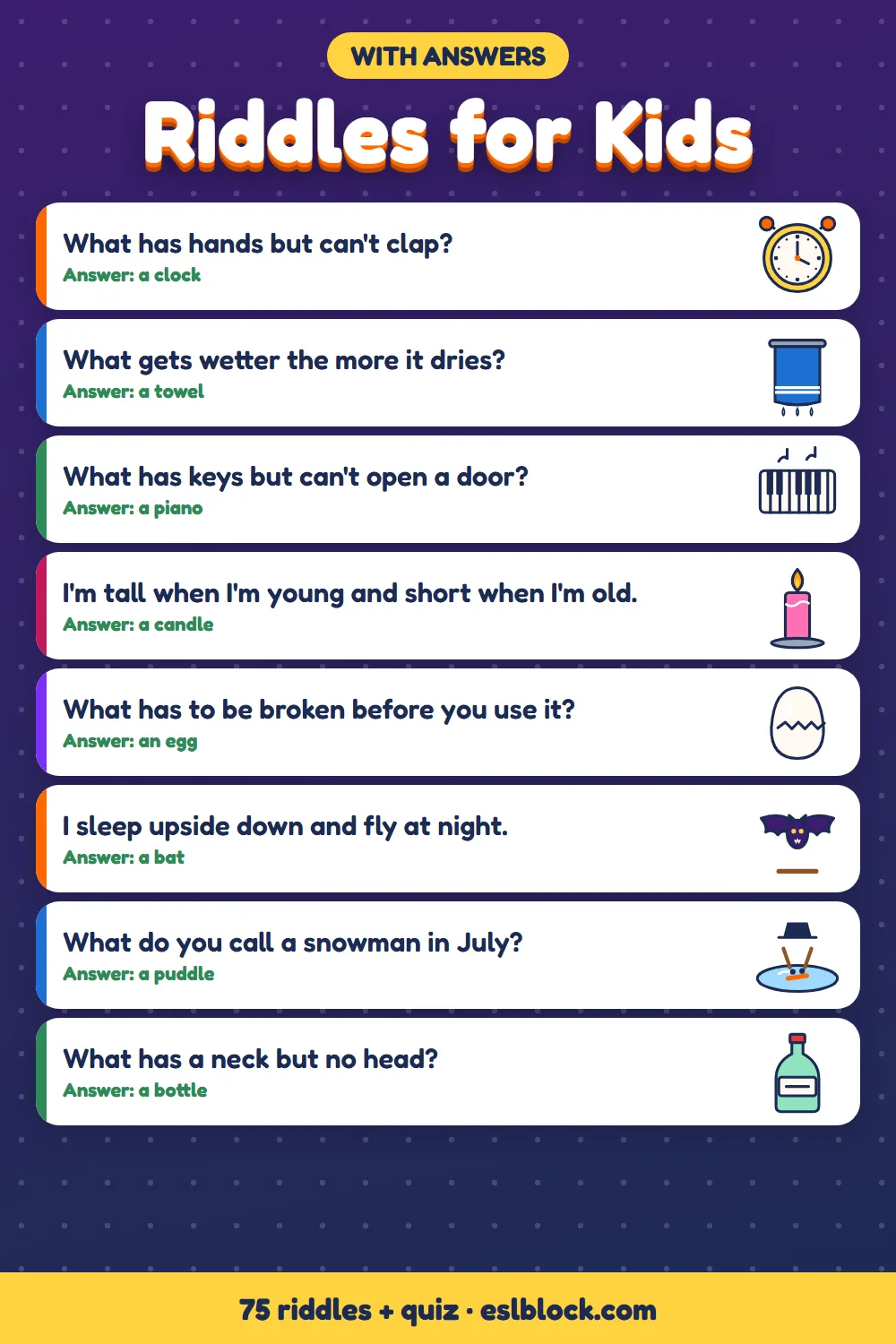
Want to test yourself? Our riddle quiz has 15 questions, and it tells you the answer straight away.
Easy riddles for kids
These easy riddles use everyday things a young child already knows, like towels, eggs and tables. Most of them follow one pattern: “What has X but can’t Y?” Once kids spot the pattern, they start making up their own.
1. What has hands but can’t clap?
Answer: A clock.
2. What has to be broken before you can use it?
Answer: An egg.
3. What has legs but can’t walk?
Answer: A table.
4. What gets wetter the more it dries?
Answer: A towel.
5. What has a neck but no head?
Answer: A bottle.
6. What has keys but can’t open a door?
Answer: A piano.
7. What has teeth but can’t bite?
Answer: A comb.
8. What goes up but never comes down?
Answer: Your age.
9. What has one eye but can’t see?
Answer: A needle. The “eye” of a needle is the little hole the thread goes through.
10. What can you catch but not throw?
Answer: A cold. In English we “catch a cold” when we get sick.
11. What has lots of words but never talks?
Answer: A book.
12. What is full of holes but still holds water?
Answer: A sponge.
13. What has a bed but never sleeps?
Answer: A river. A riverbed is the ground at the bottom of a river.
14. What comes down but never goes up?
Answer: Rain.
15. What belongs to you, but other people use it more than you do?
Answer: Your name.
Funny riddles for kids
Funny riddles are really jokes in riddle form. The answer is usually a pun, so the laugh comes when a child hears the second meaning. That’s also why they’re great for English learners: every punchline is a little vocabulary lesson. If your kids want more after these, Super Silly Jokes for Kids has over 200 clean jokes and riddles for ages 5 to 10.
16. Why did the teddy bear say no to dessert?
Answer: Because it was stuffed. “Stuffed” means full of food, and teddy bears are full of stuffing.
17. What do you call a sleeping dinosaur?
Answer: A dino-snore.
18. Why can’t a bicycle stand up on its own?
Answer: Because it’s two tired. “Two tired” sounds like “too tired”. A bike has two tyres.
19. What do you call a fish with no eyes?
Answer: A fsh. Take the letter i (eye) out of fish.
20. Why did the math book look sad?
Answer: It had too many problems.
21. What kind of tree fits in your hand?
Answer: A palm tree.
22. Why are ghosts bad at telling lies?
Answer: Because you can see right through them.
23. What do you call cheese that isn’t yours?
Answer: Nacho cheese. “Nacho” sounds like “not your”.
24. Why did the cookie go to the doctor?
Answer: It was feeling crummy. “Crummy” means bad, and cookies make crumbs.
25. What has four wheels and flies?
Answer: A garbage truck.
26. Why did the student eat his homework?
Answer: The teacher said it was a piece of cake. “A piece of cake” means very easy.
27. What room has no doors or windows?
Answer: A mushroom.
What am I? riddles
In a “what am I?” riddle, the answer talks about itself. Read the clues slowly, one at a time, and let kids guess after each line. They’re perfect for car trips and waiting rooms because you don’t need anything but your voice.
28. I have a head and a tail, but no body. I’m not a snake. What am I?
Answer: A coin.
29. I’m tall when I’m young and short when I’m old. What am I?
Answer: A candle.
30. I follow you everywhere when the sun is out, but I disappear in the dark. What am I?
Answer: Your shadow.
31. I have cities but no houses, forests but no trees, and rivers but no fish. What am I?
Answer: A map.
32. I can fly without wings and cry without eyes. What am I?
Answer: A cloud.
33. I have a thumb and four fingers, but I’m not alive. What am I?
Answer: A glove.
34. The more of me you take, the more you leave behind. What am I?
Answer: Footsteps.
35. I go all around the world but stay in one corner. What am I?
Answer: A stamp.
36. I have a ring, but no finger. What am I?
Answer: A phone. Phones “ring” when someone calls.
37. You can see me in water, but I never get wet. What am I?
Answer: Your reflection.
Animal riddles for kids
Animal riddles teach real facts along with the fun. A kangaroo has a pouch, and a chameleon changes colour. For more animal words to build your own riddles, look at our list of 50 wild animal names.
38. I’m a big cat with orange fur and black stripes. What am I?
Answer: A tiger.
39. I move very slowly, carry my house on my back and leave a shiny trail. What am I?
Answer: A snail.
40. I sleep upside down all day and fly around at night. What am I?
Answer: A bat.
41. I have a very long neck and eat leaves from the tops of trees. What am I?
Answer: A giraffe.
42. I’m black and white, I can’t fly, and I love swimming in icy water. What am I?
Answer: A penguin.
43. I have eight arms and live in the sea. What am I?
Answer: An octopus.
44. I hop on two big feet and carry my baby in a pouch. What am I?
Answer: A kangaroo.
45. I can change my colour to hide on a branch. What am I?
Answer: A chameleon.
46. I’m a pink bird and I often stand on one leg. What am I?
Answer: A flamingo.
47. First I’m an egg, then a caterpillar, and then I get wings. What am I?
Answer: A butterfly.
Hard riddles for kids
Hard riddles need kids to think about words in a new way, so they’re best for ages 9 and up. Give a hint if the room goes quiet for too long. For example, for riddle 53, ask “What letter sounds like a drink?” When your family runs out of these, Difficult Riddles for Smart Kids has 300 more brain teasers.
48. What can you hold in your right hand but never in your left hand?
Answer: Your left hand.
49. What word gets shorter when you add two letters to it?
Answer: Short (short + er = shorter).
50. What breaks as soon as you say its name?
Answer: Silence.
51. What has 13 hearts but no other body parts?
Answer: A deck of cards.
52. The more there is, the less you see. What is it?
Answer: Darkness.
53. What starts with T, ends with T and has T in it?
Answer: A teapot. It has tea in it, and “tea” sounds like the letter T.
54. Forward I’m heavy, but backward I’m not. What am I?
Answer: A ton (backward it spells “not”).
55. What gets bigger the more you take away from it?
Answer: A hole.
56. If you drop me I’ll crack, but smile at me and I’ll smile back. What am I?
Answer: A mirror.
57. Which word is always spelled wrong in the dictionary?
Answer: Wrong.
Math riddles for kids
Math riddles look like sums, but most of them are about reading carefully. The farmer one catches adults too, because the answer is in the question.
58. What has three feet but can’t walk?
Answer: A yardstick. A yard is three feet long.
59. There are three apples and you take away two. How many apples do you have?
Answer: Two. You took them!
60. I’m an odd number. Take away one letter and I become even. What number am I?
Answer: Seven (s-even).
61. How many times can you take 5 away from 25?
Answer: Once. After that, you’re taking 5 away from 20.
62. A farmer has 15 sheep. All but 8 run away. How many are left?
Answer: Eight.
63. When I was 10, my sister was half my age. Now I’m 20. How old is she?
Answer: 15. She’s always 5 years younger.
64. Which three numbers give the same answer when you add them or multiply them?
Answer: 1, 2 and 3 (1 + 2 + 3 = 6 and 1 × 2 × 3 = 6).
65. Why was six afraid of seven?
Answer: Because seven eight nine. “Eight” sounds like “ate”.
Christmas riddles for kids
These Christmas riddles work well for a class party or an advent calendar. Write one riddle a day on a slip of paper and open it in the morning. To warm up first, teach the words in our Christmas vocabulary list.
66. What do snowmen eat for breakfast?
Answer: Snowflakes.
67. What falls at the North Pole but never gets hurt?
Answer: Snow.
68. I have a trunk but I’m not an elephant, and in December I wear lights. What am I?
Answer: A Christmas tree.
69. What do you call a reindeer with no eyes?
Answer: No idea. Say it fast: “no-eye deer” sounds like “no idea”.
70. Who says “oh, oh, oh”?
Answer: Santa walking backwards.
71. I’m red and white, shaped like a hook, and you can hang me on the tree or eat me. What am I?
Answer: A candy cane.
72. What’s an elf’s favourite subject at school?
Answer: The elf-abet. It sounds like “alphabet”.
73. What do you call a snowman in July?
Answer: A puddle.
74. I hang by the fireplace and get filled with treats. What am I?
Answer: A stocking.
75. What kind of ball doesn’t bounce?
Answer: A snowball.
Why riddles help kids learn English
The Cambridge Dictionary calls a riddle a question that “describes something in a difficult and confusing way and has a clever or funny answer”. So to solve one, a child has to notice that a word can mean two things. The “eye” of a needle isn’t really an eye, and that’s the joke.
Researchers at UCL tested children aged 4 to 11 on riddles. Their study found that children with bigger vocabularies understood riddle jokes better. Only children aged 8 or older showed a reliable link between laughing and really understanding the joke. So if a five-year-old laughs, ask them to explain it. You might be surprised.
Many riddles also hide homophones, words that sound the same but mean different things, like tired and tyred or eight and ate. If your learners enjoy those, our list of 100 common homophones is the next step.
People have told riddles for thousands of years, too. Britannica retells the Greek myth of the Sphinx, who asked travellers what walks on four legs, then two, then three. Oedipus answered “man”, because a baby crawls, an adult walks and an old person uses a walking stick.
How to use riddles in class or at home
- Start the lesson with one riddle on the board. Give the answer at the end of class, so students keep thinking.
- Ask students to explain the answer in a full sentence, such as “It’s a towel because it gets wet when it dries you.” That turns a joke into speaking practice.
- Play riddle teams. One team reads a riddle, and the other team has 30 seconds to answer.
- After acting games like our charades for kids generator, try acting out the answer to a riddle instead of saying it.
- Keep a riddle jar at home. Whoever empties the dishwasher gets to pick one for dinner.
Make your own riddle in 3 steps
- Pick an everyday object, like an umbrella.
- List what it has and what it does: it has a handle, it opens, it keeps you dry.
- Turn one fact into a puzzle: “What opens when it rains but isn’t a door?”
Kids love testing their riddles on grown-ups. It’s also great writing practice, because they need to choose each word carefully.
Free printable riddle cards
Print the riddle cards, cut them out and fold them in half. The riddle goes on the front and the answer on the back. Use them in a lunchbox, as a morning warm-up or in a riddle jar.
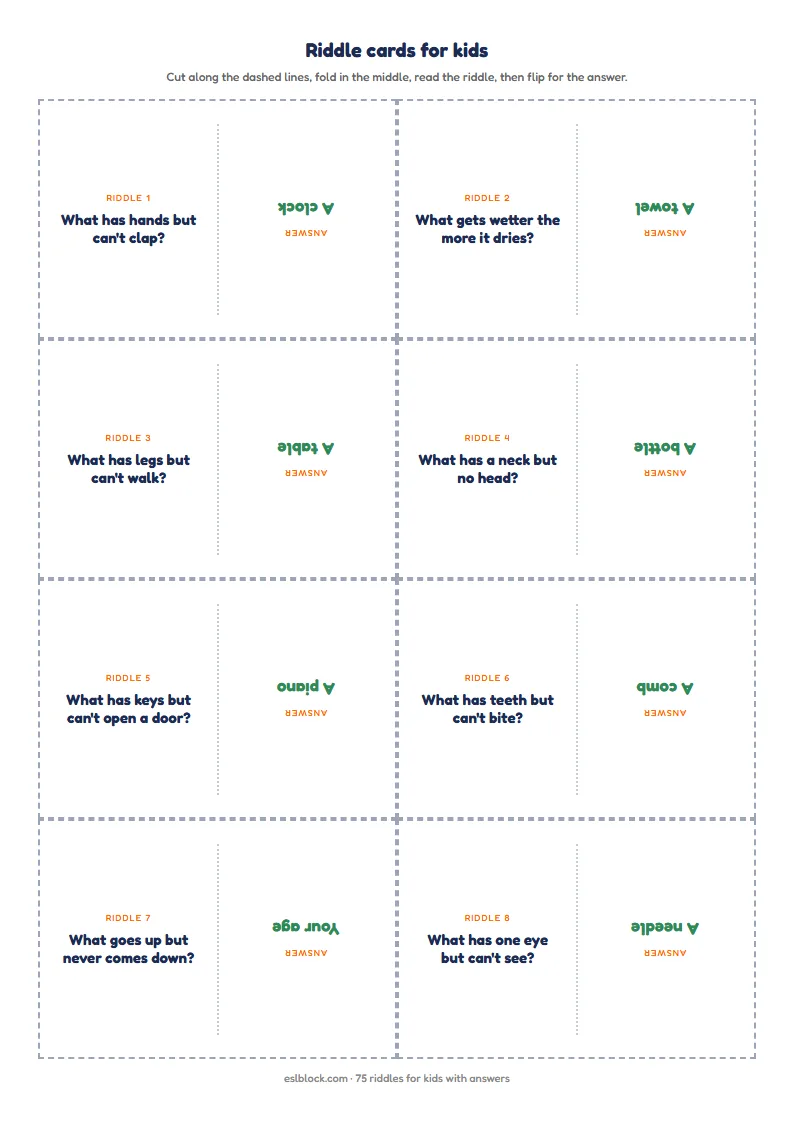
Download: 24 printable riddle cards with answers (PDF)
Mini quiz: can you solve these?
- What has a neck but no head?
- What do you call a sleeping dinosaur?
- I’m tall when I’m young and short when I’m old. What am I?
- What gets bigger the more you take away?
- What do you call a snowman in July?
- What has three feet but can’t walk?
Answers: 1. a bottle, 2. a dino-snore, 3. a candle, 4. a hole, 5. a puddle, 6. a yardstick.
FAQ
What are good riddles for kids?
Good riddles for kids use things they already know, such as clocks, towels and animals, and have one clear answer. “What has hands but can’t clap?” (a clock) and “What gets wetter the more it dries?” (a towel) are two favourites.
What is the hardest riddle for kids?
Riddles that play with words are the hardest, like “What word gets shorter when you add two letters?” The answer is “short”, which becomes “shorter”. Most kids under 9 need a hint for those.
At what age do kids understand riddles?
Many children start enjoying simple riddles at around 5 or 6. In the UCL study, children aged 8 and older were much more likely to truly understand the joke when they laughed at it, so expect wordplay riddles to click at about that age.
How do riddles help children learn?
Riddles make kids think about what words really mean, and puns show that one word can have two meanings. They also build listening, patience and confidence when a child finally gets the answer.
What is a riddle with an answer that’s an animal?
Try “I hop on two big feet and carry my baby in a pouch. What am I?” The answer is a kangaroo. There are ten more animal riddles above.
So, what has hands but can’t clap? Your kids know now, and they’ve got 74 more riddles to try on you. Pick three for tonight, then see how many they can get in the riddles quiz.
As an Amazon Associate, ESL Block earns from qualifying purchases.
More fun for kids
- 101 would you rather questions for kids
- Charades for kids: free generator with pictures
- Homophones: 100 common pairs with meanings
References
- Cambridge Dictionary: riddle
- Purser, Van Herwegen and Thomas (2020), The development of children’s comprehension and appreciation of riddles, UCL
- Britannica: sphinx summary