Homophones: 100 Common Homophones with Meanings and Examples
What is a homophone? Learn 100 common homophones with meanings and example sentences, the mistakes people make most, memory tricks, a quiz and free printable worksheets.
A friend once gave me a birthday card that said “Your the best!” It was a lovely card. But one small word was wrong, and it’s the most common homophones mistake in English. The writer meant you’re, which sounds exactly like your.
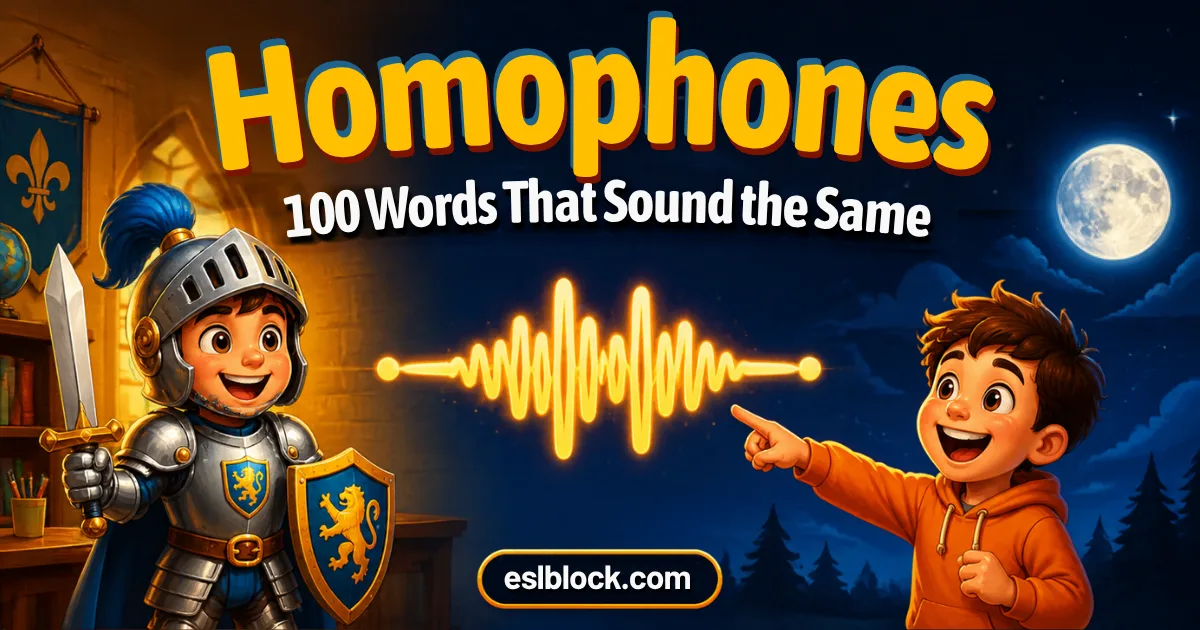
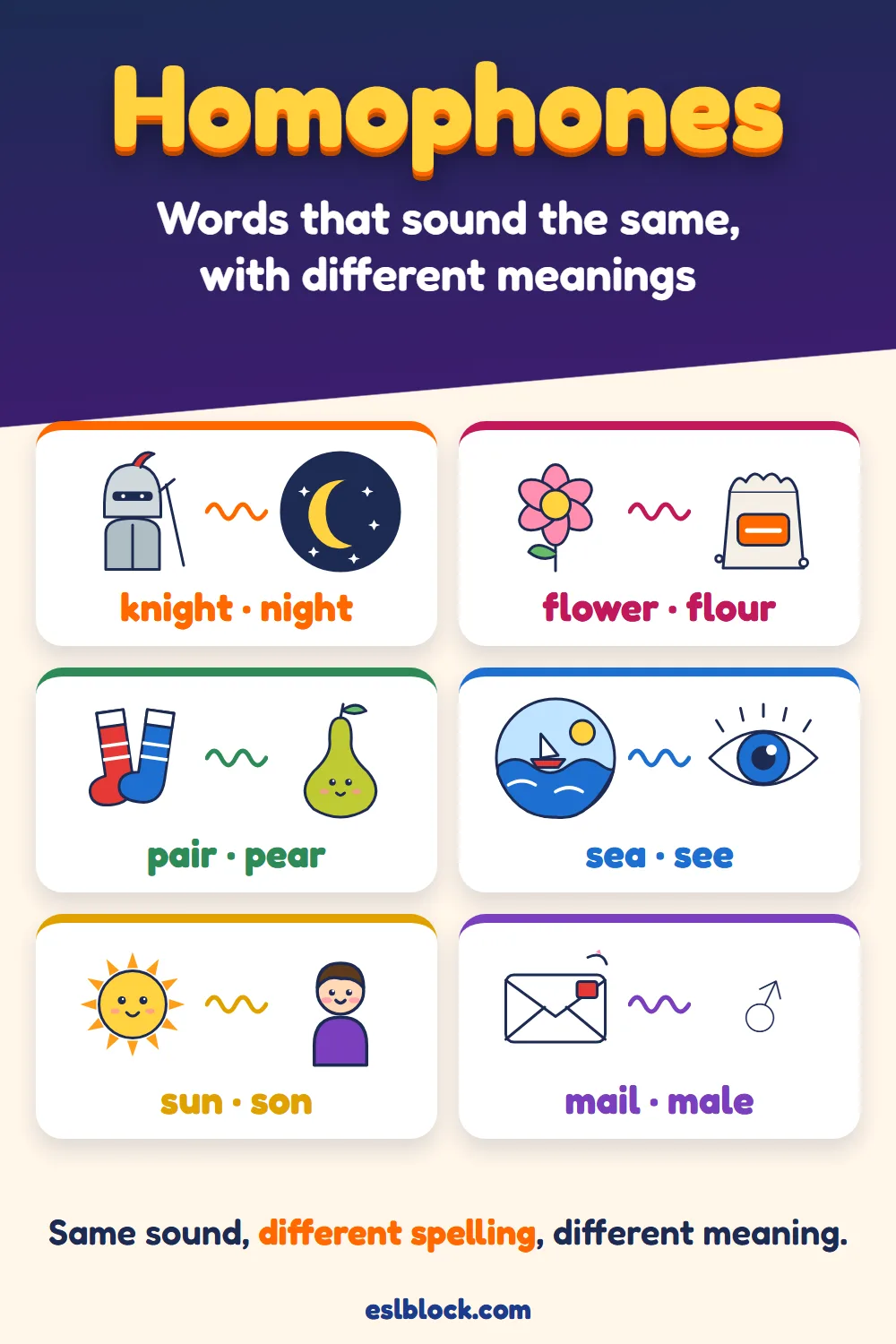
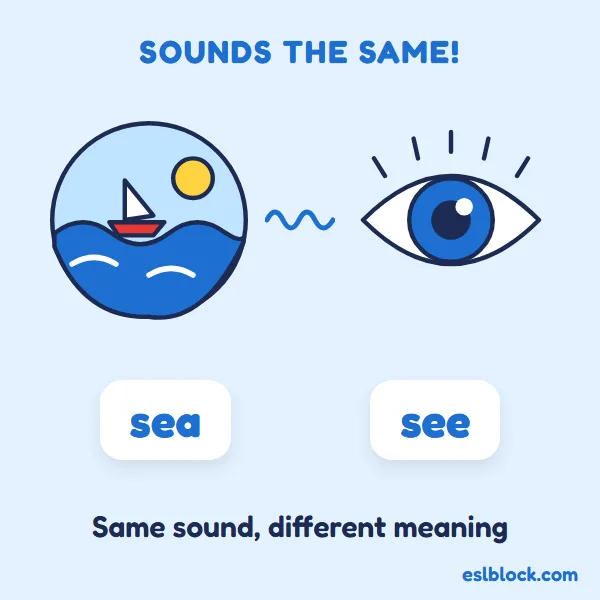
A homophone is a word that sounds the same as another word but has a different meaning or spelling. Sea and see are homophones. So are two, too and to. Below are 100 common homophones in four groups, from easy pairs for kids to tricky ones that catch adults, each with a meaning and an example sentence.
Quick examples: sea / see · flower / flour · night / knight · there / their / they’re · your / you’re · its / it’s · piece / peace · weather / whether.
📱 Prefer swiping? Flip through our 1-minute homophones story. It covers the key words with pictures, plus a quick challenge.
Think you know them all? Try the 15-question homophones quiz.
What is a homophone?
The Cambridge Dictionary defines a homophone as a word that is pronounced the same as another word but has a different meaning or spelling. The name comes from Greek: homo means “same” and phone means “sound”. So homophones are “same-sound” words.
In fact, most homophones come in pairs, like bear and bare. Some come in threes, like right, write and rite. You can’t tell them apart when you hear them, so the meaning comes from the rest of the sentence. That’s why they cause so many spelling mistakes.
Homophones, homonyms and homographs: what’s the difference?
| Word | Sounds the same? | Spelled the same? | Example |
|---|---|---|---|
| Homophone | Yes | Usually no | sea / see, knight / night |
| Homograph | Not always | Yes | bow (a ribbon) / bow (bend forward) |
| Homonym | Yes | Yes | bat (an animal) / bat (for baseball) |
The terms overlap, and even dictionaries use them a little differently. Merriam-Webster explains the three words simply: homophones share a sound, homographs share a spelling, and homonym is the umbrella term. For words that look and sound the same, see our guide to homonyms in English.
Easy homophones for kids (30 pairs)
Start with these. For example, each pair uses words that children meet early, in picture books and first spelling lists. If your child likes stories, the picture book Dear Deer: A Book of Homophones is full of pairs like these, told through a silly zoo.
| Homophones | Meanings | Example |
|---|---|---|
| sea / see | a big body of salt water / use your eyes | I can see the sea. |
| son / sun | a boy child / the star in our sky | My son likes the sun. |
| eye / I | the part you see with / me | I have something in my eye. |
| bee / be | an insect that makes honey / to exist | Be careful of the bee. |
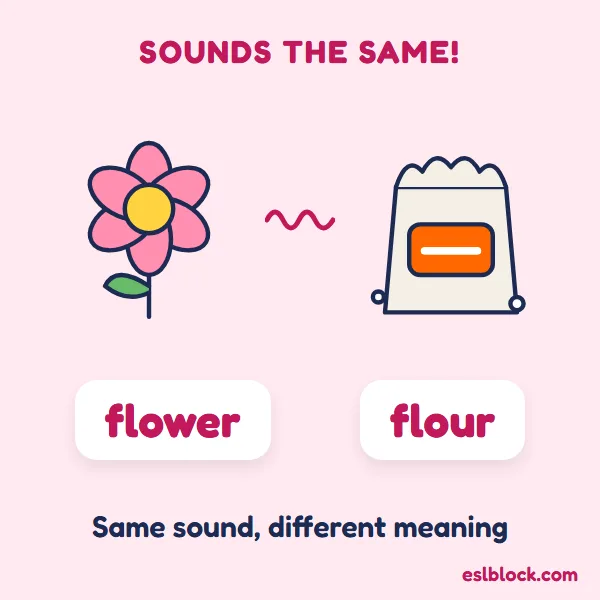
| flower / flour | a plant’s bloom / white powder for baking | She spilled flour on the flower. |
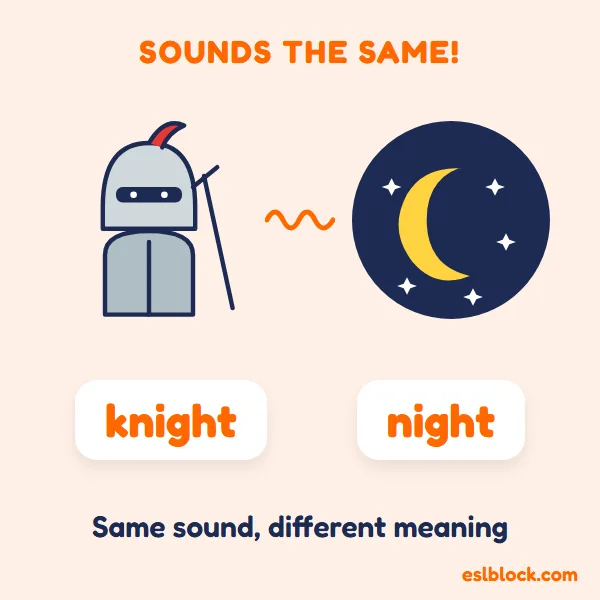
| night / knight | dark time / a soldier in armour | The knight rode all night. |
| tail / tale | the end of an animal / a story | It’s a tale about a dog’s tail. |
| hear / here | listen with your ears / in this place | Come here so I can hear you. |
| week / weak | seven days / not strong | I felt weak all week. |
| one / won | the number 1 / past of win | Our team won one game. |
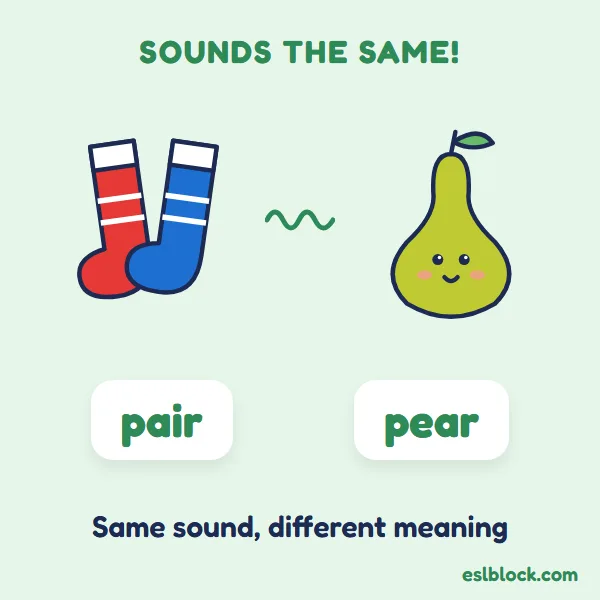
| pair / pear | two things / a fruit | I bought a pair of pears. |
| blue / blew | a colour / past of blow | The wind blew my blue hat away. |
| meet / meat | come together / food from animals | Let’s meet at the meat shop. |
| road / rode | a street / past of ride | We rode our bikes down the road. |
| hole / whole | an empty space / all of something | The dog dug a hole in the whole garden. |
| mail / male | letters and parcels / a man or boy | The male cat sat on the mail. |
| deer / dear | a forest animal / loved | My dear friend saw a deer. |
| bear / bare | a big furry animal / with nothing on | The bear had bare paws. |
| ate / eight | past of eat / the number 8 | I ate eight grapes. |
| hair / hare | grows on your head / a wild rabbit | The hare had soft hair. |
| knows / nose | has learned / the part you smell with | She knows her nose is cold. |
| plane / plain | an aircraft / simple | The plane was plain white. |
| sail / sale | a boat’s cloth / selling cheaply | Boat sails are on sale. |
| toe / tow | part of your foot / pull a car | The truck will tow the car. |
| not / knot | no / a tied loop | I can not undo this knot. |
| red / read | a colour / past of read | I read a red book. |
| hi / high | hello / far up | Say hi to the kite up high. |
| new / knew | not old / past of know | I knew you had a new bike. |
| sum / some | the total / a few | Some sums are easy. |
| flew / flu | past of fly / an illness | He flew home with the flu. |
Also, notice how many of these pairs include a past-tense verb, like won, blew and rode. If a learner isn’t sure which spelling to use, check the verb form with our verb forms finder.
Homophone triplets (15 sets)
These come in threes. As a result, there are more ways to get them wrong. Learn the meaning of each one, not just the sound.
| Homophones | Meanings | Example |
|---|---|---|
| to / too / two | toward / also, or more than enough / the number 2 | Two of us want to come too. |
| there / their / they’re | in that place / belonging to them / they are | They’re putting their coats over there. |
| for / four / fore | meant for / the number 4 / the front | I bought four tickets for us. |
| by / buy / bye | next to / pay for / goodbye | Say bye, then buy the bread by the door. |
| right / write / rite | correct, or not left / put words on paper / a ceremony | Write the right answer. |
| so / sew / sow | therefore / stitch with a needle / plant seeds | I can sew, so I’ll fix it. |
| wear / where / ware | have clothes on / which place / goods for sale | Where can I wear this? |
| sight / site / cite | the ability to see / a place / quote a source | The building site was quite a sight. |
| peek / peak / pique | a quick look / the top / make curious | Take a peek at the mountain peak. |
| vain / vein / vane | too proud / a blood tube / a wind pointer | The weather vane spun in the wind. |
| rain / reign / rein | water from clouds / a king’s rule / a strap for a horse | Hold the rein tightly in the rain. |
| you / ewe / yew | the person I’m talking to / a female sheep / a kind of tree | You can see a ewe under the yew. |
| cent / scent / sent | a coin / a smell / past of send | She sent a candle with a lovely scent. |
| aisle / I’ll / isle | a path between seats / I will / an island | I’ll take the aisle seat. |
| carrot / carat / karat | an orange vegetable / a weight for gems / gold purity | That ring has a two-carat diamond. |
Getting the hang of it? The quiz has 15 questions on these words.
Spelling-test homophones (30 pairs)
These turn up in school spelling tests from about age 8, and they’re good practice for English learners at B1 level.
| Homophones | Meanings | Example |
|---|---|---|
| allowed / aloud | permitted / out loud | We’re not allowed to read aloud here. |
| board / bored | a flat piece of wood / not interested | I was bored, so I drew on the board. |
| brake / break | a car’s stopping part / smash, or a rest | Use the brake, or you’ll break the fence. |
| ceiling / sealing | the top of a room / closing tightly | He’s sealing the crack in the ceiling. |
| cereal / serial | breakfast grains / in a series | I watch a serial while eating cereal. |
| cheap / cheep | low price / a bird’s sound | The chick went cheep. |
| chews / choose | bites food / pick | Choose the dog toy he chews most. |
| groan / grown | a sound of pain / past of grow | The grown-ups gave a groan. |
| guessed / guest | past of guess / a visitor | I guessed who the guest was. |
| heal / heel | get better / the back of your foot | My heel will heal soon. |
| hour / our | 60 minutes / belonging to us | Our bus comes in an hour. |
| knead / need | press dough / must have | You need to knead the dough. |
| lessen / lesson | make smaller / a class | Practice will lessen your mistakes in the lesson. |
| mist / missed | light fog / past of miss | I missed the bus in the mist. |
| passed / past | past of pass / earlier time, or beyond | We passed the shop and walked past the park. |
| patience / patients | calm waiting / people a doctor treats | The nurse has patience with her patients. |
| piece / peace | a part / calm, no war | I want a piece of cake and some peace. |
| pole / poll | a long stick / a vote or survey | The poll asked about the flag pole. |
| roll / role | turn over, or a bread bun / a part in a play | She got the role of the bread roll. |
| scene / seen | a place or part of a film / past participle of see | Have you seen the last scene? |
| steal / steel | take without asking / a strong metal | Nobody can steal this steel box. |
| stair / stare | a step / look for a long time | Don’t stare at me from the stair. |
| threw / through | past of throw / from one side to the other | He threw the ball through the window. |
| wait / weight | stay until / how heavy | Wait while I check the weight. |
| waist / waste | the middle of your body / throw away, use badly | Don’t waste time on that belt for your waist. |
| weather / whether | sun, rain and so on / if | We’ll go whether the weather is good or not. |
| which / witch | what one / a woman with magic | Which witch has the black cat? |
| wood / would | material from trees / past of will | Would you like a wood or metal table? |
| flea / flee | a tiny jumping insect / run away | The dog tried to flee from the flea. |
| berry / bury | a small fruit / put in the ground | The squirrel will bury a berry. |
For more spelling practice, hide ten of these pairs in a puzzle with our free word search maker. Learners have to look at every letter, which is exactly what homophones need.
Advanced homophones for teens and adults (25 pairs)
| Homophones | Meanings | Example |
|---|---|---|
| compliment / complement | praise / complete or go well with | She paid me a compliment on how the scarf complements my coat. |
| principal / principle | head of a school / a basic rule | The principal explained the main principle. |
| stationary / stationery | not moving / paper and pens | The stationery shop stayed stationary. |
| capital / capitol | a main city / a government building (US) | The capitol is in the capital. |
| council / counsel | a group that makes decisions / advice | The council asked for legal counsel. |
| faze / phase | upset / a stage | Nothing could faze her in this phase. |
| lead / led | a heavy metal / past of lead | She led us to the old lead pipes. |
| morning / mourning | early part of the day / feeling sad after a death | They were in mourning that morning. |
| muscle / mussel | body tissue / a shellfish | You don’t need muscle to open a mussel. |
| pedal / peddle | a foot lever / sell door to door | He used a bike to peddle cakes. |
| prey / pray | an animal that is hunted / speak to a god | The mouse is the owl’s prey. |
| bridal / bridle | about a bride / a horse’s head straps | The bridal party rode horses with white bridles. |
| coarse / course | rough / a class, or a route | The golf course had coarse sand. |
| discreet / discrete | careful, private / separate | Be discreet about the discrete parts. |
| cue / queue | a signal / a line of people | That’s your cue to join the queue. |
| idle / idol | doing nothing / someone admired | My idol is never idle. |
| medal / meddle | a prize / interfere | Don’t meddle with my medal. |
| naval / navel | about a navy / belly button | A naval officer showed us his navel orange. |
| palate / palette | the roof of your mouth, or taste / a painter’s board | The artist has a fine palate and a messy palette. |
| sole / soul | only, or the bottom of a shoe / spirit | He was the sole singer with real soul. |
| suite / sweet | a set of rooms / sugary | The hotel suite had sweet chocolates. |
| tide / tied | rise and fall of the sea / past of tie | We tied the boat before the tide came in. |
| wail / whale | a long cry / a huge sea animal | Did you hear the whale’s wail? |
| wrap / rap | cover in paper / fast spoken music, or knock | Wrap the gift before the rap concert. |
| yoke / yolk | a wooden bar for oxen / the yellow part of an egg | The farmer’s eggs had bright yolks. |
The homophones people mix up most
| Pair | Quick test | Right / wrong |
|---|---|---|
| your / you’re | Can you say “you are”? Then it’s you’re. | You’re late. ✔ Your late. ✘ |
| its / it’s | Can you say “it is”? Then it’s it’s. | The dog wagged its tail. ✔ It’s tail ✘ |
| their / there / they’re | Their = owns something. There = place. They’re = they are. | They’re in their room over there. ✔ |
| to / too / two | Too means “also” or “more than enough”. Two is a number. | It’s too hot to go. ✔ It’s to hot ✘ |
| whose / who’s | Can you say “who is”? Then it’s who’s. | Who’s coming? Whose bag is this? ✔ |
The trick in every case is the apostrophe. An apostrophe in these words shows that letters are missing: you’re is short for you are, and it’s is short for it is.
Tricks to remember homophones
- Hear has an “ear” in it, and you hear with your ear.
- Here, there and where are all about places, and they all contain “here”.
- A piece of pie: both start with “pie”.
- The principal is your pal. A principle is a rule.
- Stationery with an E is for envelopes. Stationary with an A means standing still.
- Too has too many o’s.
- Dessert isn’t a homophone of desert, but it has two s’s because you always want seconds.
Drawing helps too, because it links each spelling to a picture. Ask learners to draw both words in a pair, like a knight and the night sky, then label them. You can turn it into a game with our Pictionary word generator by adding homophones as your own words. For a ready-made version, Junior Learning homophone cards have 65 picture cards that work well for matching and memory games.
Free homophones worksheets (PDF)
Three printables to practise the lists above: a fill-in-the-gap worksheet, homophone memory cards to cut out, and a mixed-up sentences page with an answer key.
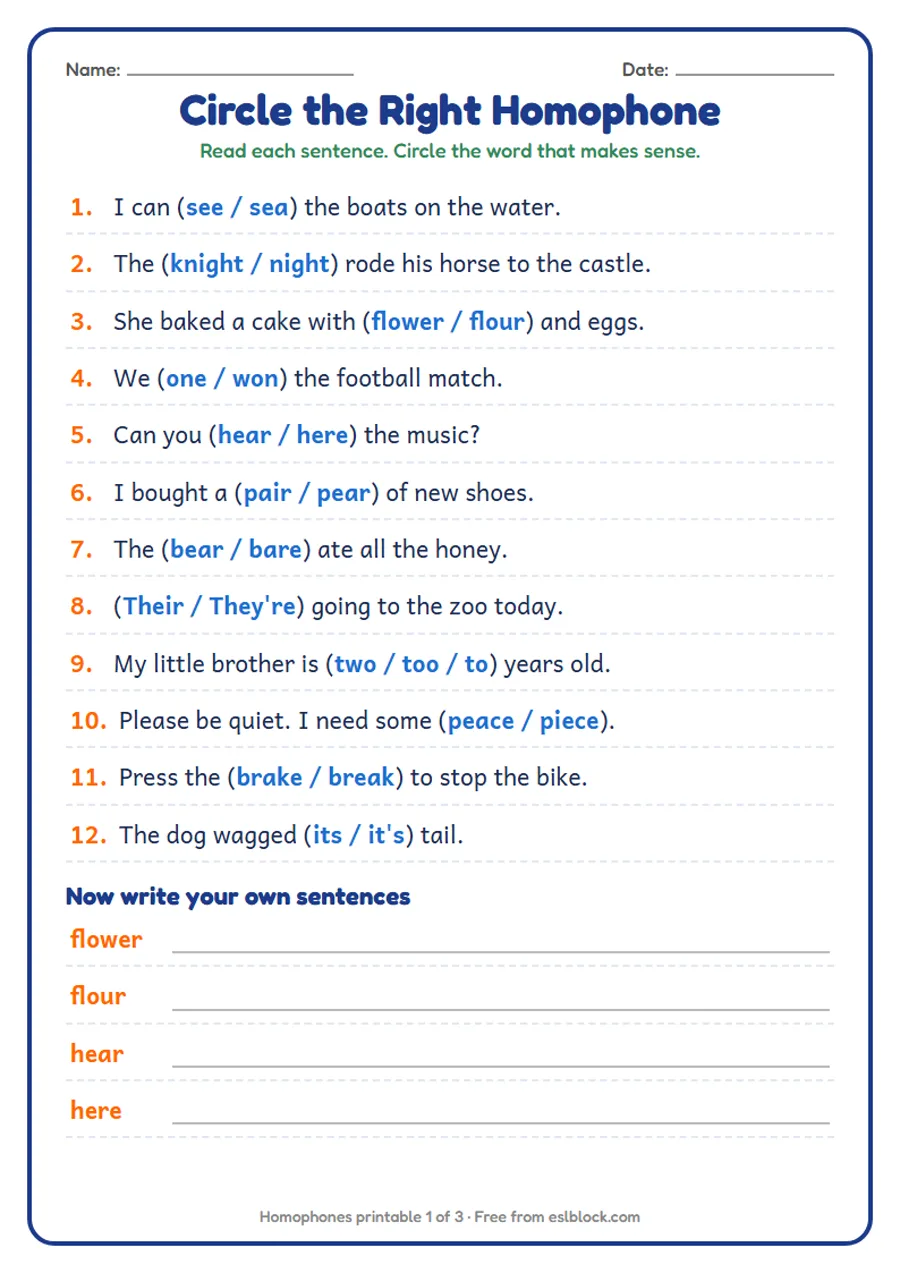
Download: all 3 printables (PDF) · fill-in-the-gap worksheet · memory cards · mixed-up sentences + answers
Mini quiz: which homophone?
Choose the right word. Answers are below.
- I can ___ the sea. (see / sea)
- ___ going to the park after school. (Their / They’re)
- The dog wagged ___ tail. (its / it’s)
- We ___ the match on Saturday. (one / won)
- Please read the poem ___. (allowed / aloud)
- I’d like a ___ of cake. (peace / piece)
- Use the ___ to stop the car. (break / brake)
- We’ll go ___ it rains or not. (weather / whether)
Answers: 1. see · 2. They’re · 3. its · 4. won · 5. aloud · 6. piece · 7. brake · 8. whether
Got all 8? Try the full 15-question quiz.
FAQ
What is a homophone?
A homophone is a word that sounds the same as another word but has a different meaning, and usually a different spelling. Merriam-Webster gives to, too and two as a classic example.
What are 10 examples of homophones?
Sea and see, flower and flour, night and knight, hear and here, one and won, pair and pear, meet and meat, bear and bare, your and you’re, and piece and peace.
What’s the difference between homophones and homonyms?
Homophones sound the same but are usually spelled differently, like knight and night. Homonyms sound the same and are spelled the same but mean different things, like bat the animal and bat for baseball.
Are homophones the same in British and American English?
Mostly, but accents change a few. In many American accents, aunt and ant sound the same. In most British accents, court and caught sound the same, but in many American accents they don’t.
How do you teach homophones to kids?
Teach one pair at a time with pictures, so children connect each spelling to a meaning. Then use the pair in short sentences, play memory or matching games, and add a few pairs to the weekly spelling list. Start with the easy list above.
That birthday card still makes me smile, but now you know the fix: if you can say “you are”, write you’re. Pick five pairs from the easy list today, write a sentence for each, and the next card you write will be perfect.
As an Amazon Associate, ESL Block earns from qualifying purchases.
More word lessons
- Homonyms in English: same spelling, different meanings
- Free word search maker
- Pictionary word generator
References
- Cambridge Dictionary: homophone
- Merriam-Webster: homophone
- Merriam-Webster: homophones, homographs and homonyms