Winter Vocabulary: 50 Winter Words in English (with Pictures)
50 winter words in English with simple meanings and examples: snowy weather, warm clothes, winter sports, cosy things at home, plus a quiz.
Winter has a lot of words that only come out once a year. You probably know snow and cold, but what about sleet, slush or mittens? Below are 50 common winter words grouped by topic, each with a short meaning and an example you could actually say. There’s a scale for talking about how cold it is, the British and American differences, and a short quiz at the end.
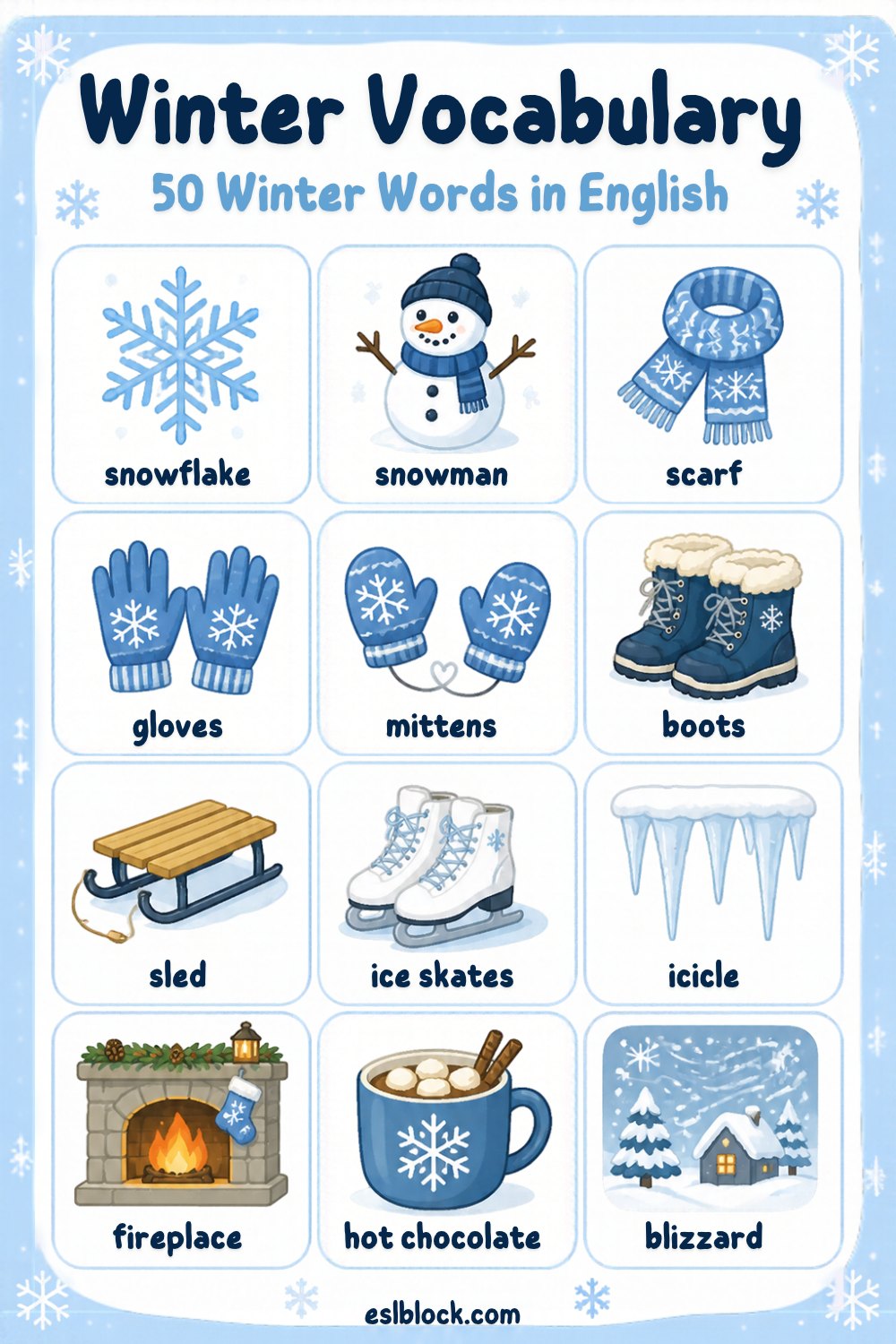
Quick list: snow, snowflake, ice, frost, blizzard, scarf, gloves, boots, coat, sledding, skiing, snowman, fireplace, hot chocolate, freezing, chilly.
📱 Prefer swiping? Flip through our 1-minute winter vocabulary story. It covers the key words with pictures, plus a quick challenge.
Ready to test yourself? Try our 15-question winter quiz.
Winter weather words
| Word | Meaning | Example |
|---|---|---|
| snow | soft white flakes of frozen water that fall from the sky | It snowed all night, so school is closed. |
| snowflake | one single piece of snow | A snowflake landed on my glove. |
| ice | water that has frozen hard | Be careful, there’s ice on the steps. |
| frost | a thin white layer of ice on cold mornings | The car windows were covered in frost. |
| icicle | a long, pointed piece of ice hanging down | Huge icicles hung from the roof. |
| blizzard | a storm with heavy snow and strong wind | We stayed inside during the blizzard. |
| snowstorm | a storm with a lot of snow | The snowstorm closed the airport. |
| sleet | rain mixed with snow or ice | It isn’t really snow, it’s sleet. |
| hail | small hard balls of ice that fall like rain | The hail was so loud on the roof! |
| slush | snow that is melting and turning wet and dirty | My shoes got soaked in the slush. |
| fog | thick cloud near the ground that is hard to see through | The fog was so thick we drove slowly. |
Not sure about sleet and hail? The Met Office explains how hail forms, and sleet is just a wet mix of rain and snow.
Winter clothes vocabulary
| Word | Meaning | Example |
|---|---|---|
| coat | a warm jacket that goes over your other clothes | Don’t forget your coat, it’s freezing! |
| scarf | a long piece of warm cloth worn around your neck | She wrapped a red scarf around her neck. |
| gloves | warm covers for your hands, with a space for each finger | I can’t text with my gloves on. |
| mittens | hand covers with one part for the thumb and one for the fingers | Little kids find mittens easier to put on. |
| woolly hat / beanie | a soft, warm hat that covers your ears | He never goes out without his beanie. |
| earmuffs | two soft pads that keep your ears warm | My earmuffs look funny but they work. |
| boots | strong shoes that cover your ankles | Wear your snow boots today. |
| sweater / jumper | a warm knitted top with long sleeves | Grandma knitted me a sweater. |
| thermals | thin warm clothes you wear under your normal clothes | Skiers usually wear thermals. |
| parka | a long, thick coat, often with a hood | My parka keeps me warm even at minus ten. |
| hood | the part of a coat that covers your head | Put your hood up, it is snowing. |
Teaching clothes to young learners? Our guide to teaching clothes names to kids has games that work well with these winter words too.
Winter activities and sports
| Word | Meaning | Example |
|---|---|---|
| sledding / sledging | sliding down a snowy hill on a sled | We went sledding after lunch. |
| skiing | moving over snow on two long, narrow boards | I’m learning skiing this winter. |
| snowboarding | riding down snow on one wide board | Snowboarding is harder than it looks. |
| ice skating | gliding on ice wearing special boots with blades | Let’s go ice skating at the park. |
| snowball fight | a game where people throw snowballs at each other | The snowball fight lasted an hour. |
| make a snow angel | lie in snow and move your arms and legs to make an angel shape | The kids made snow angels in the garden. |
| build a snowman | make a figure out of snow | Do you want to build a snowman? |
| hibernate | when animals sleep through the whole winter | Bears hibernate until spring. |
| stay in | stay at home instead of going out | It’s too cold, let’s stay in tonight. |
Cosy things at home
| Word | Meaning | Example |
|---|---|---|
| fireplace | an open place for a fire inside a house | We sat by the fireplace all evening. |
| blanket | a thick cover that keeps you warm | Can I have another blanket? |
| heater | a machine that warms a room | Turn the heater on, please. |
| slippers | soft, warm shoes you wear at home | Where are my slippers? The floor is cold. |
| hot chocolate | a warm, sweet chocolate drink | Nothing beats hot chocolate after the snow. |
| soup | a hot liquid food made from vegetables or meat | Mum makes tomato soup every winter. |
| hot water bottle | a rubber bag filled with hot water for your bed | I take a hot water bottle to bed. |
Ready for a challenge? See how many winter words you really know.
Winter adjectives
| Word | Meaning | Example |
|---|---|---|
| chilly | a bit cold, not very cold | It’s a chilly morning, take a jacket. |
| freezing | extremely cold | My hands are freezing! |
| icy | covered in ice, or very cold | The roads are icy, so drive slowly. |
| frosty | covered in frost | It was a frosty morning. |
| snowy | with a lot of snow | We had a snowy weekend in the mountains. |
| cosy (UK) / cozy (US) | warm, comfortable and relaxing | The café was small and cosy. |
Want more describing words? Have a look at our guide to descriptive adjectives.
Winter verbs
| Word | Meaning | Example |
|---|---|---|
| shiver | shake because you are cold | She was shivering at the bus stop. |
| freeze | become ice, or feel very cold | The lake froze last night. |
| melt | change from ice or snow into water | The snowman melted in the sun. |
| slip | slide and nearly fall | I slipped on the ice this morning. |
| wrap up | put on lots of warm clothes | Wrap up warm, it’s snowing. |
| shovel | move snow with a big spade | Dad shovelled the snow off the path. |
How cold is it? From cool to bitterly cold
English has lots of ways to say how cold it is. Here they are from least cold to most cold:
- cool: pleasant, a light jacket is enough
- chilly: a bit cold, you notice it
- cold: you need a proper coat
- freezing: very cold, often below 0°C
- bitterly cold: so cold it hurts your face
People also say It’s nippy (UK, informal) for chilly, and It’s minus five for −5°C.
British vs American winter words
| British English | American English |
|---|---|
| jumper | sweater |
| woolly hat | beanie (Canada: toque) |
| sledge / sledging | sled / sledding |
| snowplough | snowplow |
| cosy | cozy |
| wellies (rain boots) | rain boots / galoshes |
Common mistakes with winter words
- ❌ It’s snow today. ✅ It’s snowing today. (Use the verb for weather happening now.)
- ❌ I have cold. ✅ I’m cold. But: I have a cold means you’re ill.
- ❌ It is very freezing. ✅ It is freezing. Freezing already means very cold. If you want more, say absolutely freezing.
- ❌ a snow ✅ some snow / a lot of snow. Snow is uncountable, but snowflake is countable.
Winter idioms you’ll hear
- break the ice: say something to make people feel relaxed. He told a joke to break the ice. (Cambridge)
- snowed under: having too much work. Sorry, I’m snowed under this week.
- the tip of the iceberg: a small part of a much bigger problem.
- get cold feet: suddenly feel nervous about doing something.
Quick quiz: winter vocabulary
Fill in the blank with a word from the lists above. Answers are below.
- Kids love throwing snowballs in a snowball ______.
- A storm with heavy snow and strong wind is a ______.
- Long pointed pieces of ice hanging from a roof are ______.
- Gloves have a space for each finger; ______ don’t.
- When snow turns wet and dirty, it’s called ______.
- Put on lots of warm clothes = ______ up.
- Bears sleep all winter. They ______.
- “It’s a bit cold” = It’s ______.
Answers: 1. fight, 2. blizzard, 3. icicles, 4. mittens, 5. slush, 6. wrap, 7. hibernate, 8. chilly
Got all 8? Try the full version. It has 15 questions, and a couple of them catch out even native speakers.
Winter books and activities to practise these words
Hearing the words in a story is the fastest way to make them stick. These are books and puzzles we’d happily use in class, and each one repeats vocabulary from this lesson.
- There Was a Cold Lady Who Swallowed Some Snow!: a silly, repetitive read-aloud with snow, scarf, hat and coal. Kids join in after one page.
- Snowmen at Night: what snowmen get up to while we sleep: sledding, skating and hot cocoa. Lovely for bedtime.
- Over and Under the Snow: a gentle look at animals in winter. Perfect for hibernate, frost and freezing.
- Snow: A Picture Book About Different Kinds of Snow: great for older kids who want more weather words than just snow.
- KindKids Word Search Winter Magic: cute winter word searches for quiet time, so kids keep spotting the words they just learned.
As an Amazon Associate, ESL Block earns from qualifying purchases. It doesn’t change the price you pay.
FAQ
What are some winter words in English?
Snow, ice, frost, blizzard, snowman, scarf, gloves, boots, sledding, skiing, fireplace and hot chocolate are some of the most common.
What’s the difference between gloves and mittens?
Gloves have a separate space for each finger. Mittens have one space for the thumb and one for all the other fingers together (Cambridge Dictionary).
What’s the difference between sleet and hail?
Sleet is wet: rain mixed with snow or ice. Hail is hard balls of ice that bounce when they land (Cambridge Dictionary).
When is winter?
In the northern hemisphere (the UK, the US, most of Europe and Asia) winter is December to February. In the southern hemisphere, like Australia and South Africa, it’s June to August.
More vocabulary lessons
- Christmas Vocabulary: 50 Christmas Words in English
- 150 Other Ways to Say Happy New Year
- Teaching Clothes Names to Kids
- List of Pet Animals
References
- Cambridge Dictionary: sleet
- Cambridge Dictionary: mitten
- Met Office: how snow forms
- Met Office: hail
- US National Weather Service: winter weather safety