Category Parts of Speech

The parts of speech are the building blocks of the English language and understanding them is crucial for understanding and using English grammar correctly. Whether you are a beginner or an advanced learner, understanding the parts of speech is an essential step in improving your English grammar skills.
The parts of speech are the building blocks of the English language and understanding them is crucial for understanding and using English grammar correctly.
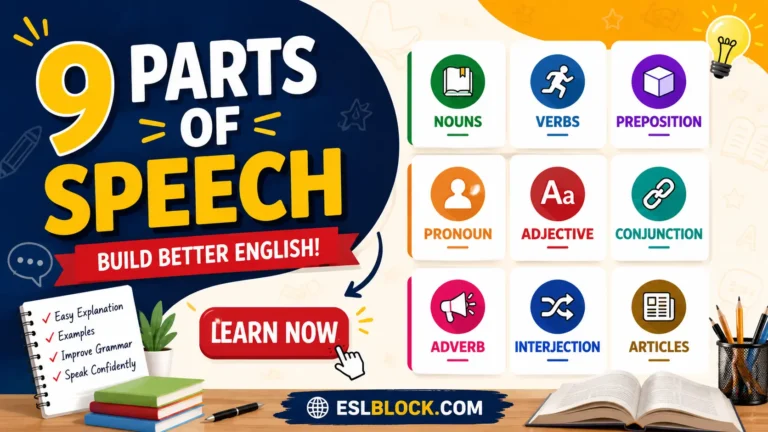
The eight parts of speech in English include nouns, pronouns, verbs, adjectives, adverbs, prepositions, conjunctions, and interjections. Each part of speech has a specific function and understanding these functions is key to understanding how sentences are constructed.

Nouns are words that name people, places, things, or ideas. Pronouns are words that take the place of nouns, such as he, she, it, and they. Verbs are words that show action or state of being, such as run, jump, or is. Adjectives describe nouns and pronouns, such as big, yellow, or happy. Adverbs describe verbs, adjectives, or other adverbs, such as quickly, very, or well. Prepositions show the relationship between a noun or pronoun and other words in a sentence, such as in, on, or under. Conjunctions join words or groups of words together, such as and, or, but. Interjections are words that express strong emotion, such as wow, ouch, or oh.

By understanding the function and examples of each parts of speech, you can improve your ability to use them correctly in your writing and speaking. Additionally, you can use this knowledge to analyze and understand sentences that you read, which will help you to improve your reading comprehension.

In addition to understanding the parts of speech, it’s important to practice using them in context. This means using them in sentences and paragraphs to create coherent and meaningful communication. You can find online resources such as exercises and quizzes that will help you practice using the parts of speech in context. Some resources also provide practice exercises for identifying the parts of speech in sentences, which can be a great way to test your understanding of the concepts.

Furthermore, it’s important to note that English is a living language, and it’s constantly evolving. While there are set rules for the parts of speech, there are also exceptions, idiomatic expressions and colloquial language which may not follow the rules.

What are Possessive Adjectives?

Adjective Words, Adjectives, Possessive Adjectives, What are Possessive Adjectives

What are Possessive Adjectives? There are many different kinds of adjectives that are part of the English language. It can be confusing. It doesn’t have to be. In this article, we’re going to examine possessive adjectives and the ways they can be used…

Adjectives to Describe Yourself

A to Z Adjectives to Describe a Person, A-Z Positive Adjectives, Adjective Words, Adjectives, Adjectives to describe yourself, Best Adjectives to Describe Yourself, Funny Words to Describe Yourself, Interesting Words to Describe Yourself, Personality Description, Physical Description, Positive Words to Describe Yourself, Situational Description, Vocabulary, Words That Describe a Person, Words to Describe Your Personality, Words to Describe Yourself in a Cover Letter or Job Application, Words to Describe Yourself in a Dating Profile, Words to Describe Yourself on a College Application

If you could describe yourself in just three words do you know what words you’d pick? It’s not as easy as it sounds, and finding them is more difficult than you’d believe. This is why we’ve put together a list of 500 words…